

Smoke in the air. Fires on the map. And a question most Riverside homeowners don’t think to ask: what’s getting through your vents rig0ht now?
This page gives you live wildfire maps and real-time AQI data for Riverside, CA. But after years of HVAC service calls across Southern California, we’ve seen firsthand what outdoor fire maps won’t show you — wildfire particulates moving silently through home HVAC systems while families assume they’re safe indoors.
Monitor what’s burning outside. Protect the air inside. This page helps you do both.
TL;DR Quick Answers
Current Live Forest Wildfire & Smoke Map Today Riverside, CA
What it is: Real-time wildfire tracking and air quality monitoring for Riverside County, CA — and a reminder that your HVAC system does far more than just blow hot or cold air.
Where to monitor:
- Active fires — fire.ca.gov/incidents
- Real-time AQI — airnow.gov
- Local alerts — readyriverside.com
What most homeowners miss:
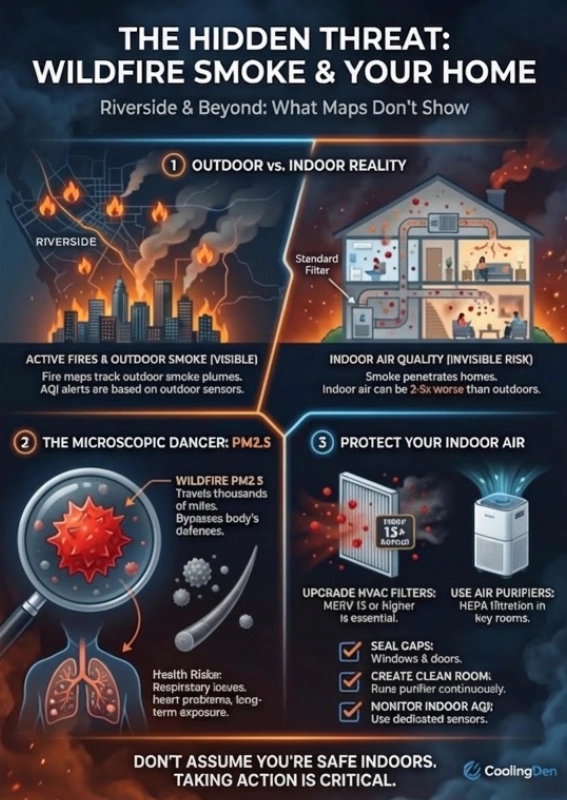
- Outdoor AQI doesn’t reflect indoor air quality
- Wildfire PM2.5 travels thousands of miles from the fire source
- HVAC systems without MERV 13 filters recirculate wildfire particulates indoors
Immediate action steps:
- Check AQI for your Riverside zip code
- Switch HVAC to recirculation mode
- Confirm filter is rated MERV 13 or higher
- Replace filter immediately after the smoke event clears
Bottom line: The map shows where the fire is. Your HVAC filter determines whether wildfire smoke stays outside or circulates through your home.
Top Takeaways
- Use three sources together — not one.
- CAL FIRE — active fire perimeters
- AirNow.gov — real-time AQI by zip code
- Ready Riverside — local evacuation alerts
- Outdoor AQI is a starting point — not a safety guarantee.
- Indoor air can be compromised even when outdoor AQI reads moderate
- Your HVAC filter rating determines what your family actually breathes
- Act before smoke is visible.
- Santa Ana winds spike AQI from moderate to hazardous within hours
- Monitor NWS red flag warnings before fire is reported
- The window to protect indoor air closes fast
- MERV 13 or higher is non-negotiable during smoke events.
- Standard 1-inch filters weren’t engineered for wildfire-grade PM2.5
- An undersized filter doesn’t just underperform — it recirculates the problem
- Post-fire filter replacement is not optional.
- Captured particulates don’t leave when smoke clears
- Replace immediately after every nearby fire event
- Resume normal HVAC operation only after filter is changed
Table of Contents
What the Wildfire Map Shows — And What It Doesn’t
Live wildfire maps track active fire perimeters, containment status, and smoke plume movement across Riverside County in real time. Key data sources include:
- CAL FIRE — active incident locations and containment updates
- AirNow.gov — real-time AQI readings by zip code
- Riverside County Emergency Management — local evacuation and shelter-in-place alerts
- Purple Air — hyperlocal sensor data from neighborhood-level monitors
What the map won’t show you: what’s happening to the air inside your home.
How Wildfire Smoke Moves Through Riverside County
Riverside County’s geography makes it uniquely vulnerable. The Santa Ana winds push fire and smoke rapidly westward through mountain passes and valley corridors — often reaching populated areas faster than evacuation alerts.
During active fire events, smoke behaves unpredictably:
- AQI can spike from Moderate to Hazardous within hours
- Smoke particles travel 50–100+ miles from the fire line
- Fine particulates (PM2.5) are invisible — you won’t see or smell every threat
- Indoor smoke levels can exceed outdoor readings when HVAC systems are unmanaged
What Riverside Homeowners Get Wrong During Wildfire Events
After years of HVAC service calls across Southern California, we’ve seen the same mistakes repeat during fire season:
- Running HVAC in “fresh air” mode — actively pulling outdoor smoke inside
- Relying on low-MERV filters — standard 1-inch filters capture large debris but allow fine wildfire particulates straight through
- Ignoring filter condition — a clogged filter during a smoke event recirculates captured particulates back into living spaces
- Checking outdoor AQI and assuming indoor safety — outdoor readings don’t account for infiltration through ductwork, gaps, and returns
How to Use This Wildfire Map to Protect Your Home
Step 1 — Monitor: Check CAL FIRE and AirNow.gov for active incidents and AQI levels in your Riverside zip code.
Step 2 — Act on your HVAC immediately:
- Switch to recirculation mode — stop pulling outdoor air in
- Verify filter rating is MERV 13 or higher
- Seal return air gaps if visible smoke or odor is present indoors
Step 3 — After the fire:
- Replace your HVAC filter immediately — captured particulates don’t leave on their own, and understanding the tradeoffs between reusable and disposable furnace filters can help you decide what to keep on hand before fire season.
- Run an air quality check indoors before returning to normal HVAC operation
- Schedule a post-fire HVAC inspection if smoke odor persists through vents — working with the best HVAC companies near you ensures your system is evaluated and sealed correctly.
Riverside Wildfire Risk: What the Data Tells Us
Riverside County consistently ranks among California’s highest-risk counties for wildfire activity. Key risk factors include:
- Climate — hot, dry summers with low humidity accelerate fire spread
- Santa Ana wind events — high-velocity offshore winds dramatically increase fire behavior
- Urban-wildland interface — dense residential neighborhoods border undeveloped fire-prone terrain, and older homes with minimal insulation installation or air sealing make it easier for smoke to slip indoors.
- Air quality baseline — Riverside already faces chronic PM2.5 challenges before fire season begins
For Riverside homeowners, wildfire smoke isn’t a rare emergency — it’s a seasonal air quality reality that demands a proactive indoor air strategy year-round.
“After years of HVAC service calls across Southern California, the most dangerous mistake we see Riverside homeowners make during wildfire season isn’t ignoring the fire map — it’s assuming a green outdoor AQI means the air inside their home is safe.”
Your Riverside Wildfire & Smoke Command Center: 7 Resources to Monitor Right Now
We’ve responded to enough post-fire HVAC calls across Southern California to know most homeowners wish they’d found these sooner. Bookmark all seven.
1. CAL FIRE Incidents See Where Fire Is Burning Right Now
The ground truth on active fire perimeters and containment status in Riverside County. This is the first map we pull up on every Southern California service call during fire season.
2. AirNow — Check AQI Before You Touch Your HVAC
Real-time AQI readings down to your Riverside zip code, including PM2.5 levels. We tell every homeowner: check this before deciding whether to run your system or switch to recirculation mode.
3. Riverside County Emergency Management Local Alerts Direct From the Source
Evacuation orders and shelter-in-place directives don’t wait for news coverage. Get Riverside County emergency notifications straight from the source — before conditions in your neighborhood escalate.
4. National Interagency Fire Center Get Ahead of Fire Season Before It Gets Ahead of You
Seasonal fire potential forecasts and national activity maps. The homeowners who prepare early — filters checked, replacements stocked — consistently fare better when conditions deteriorate fast.
5. South Coast AQMD Air Quality Alerts Built for Southern California
SCAQMD’s smoke advisories reflect the specific particulate conditions Riverside County HVAC systems deal with on the ground — more locally precise than national tools.
6. EPA Wildfire Smoke Guide Where Outdoor Fire Meets Indoor Air
The resource we point homeowners to when indoor air feels compromised despite the fire being miles away. Federal guidance on HVAC operation and filtration ratings during active smoke events.
7. National Weather Service Los Angeles Watch the Wind First
Santa Ana wind events determine how fast smoke reaches Riverside homes. We check NWS red flag warnings before anything else during high-wind season — by the time fire is visible, the window to protect your indoor air is already closing.
Supporting Statistics
Wildfire Smoke Travels Further Than Most Riverside Residents Realize
We’ve taken calls from homeowners convinced they were safe because the fire was counties away. The U.S. Geological Survey confirms the risk doesn’t respect distance:
- PM2.5 particulates travel thousands of miles from the fire source
- Distance from the fire line provides zero indoor air protection
- An unprotected HVAC system doesn’t know how far away the fire is
Fire Season in Riverside County Is Now Year-Round
“We don’t really get fires here” — we hear it often. CAL FIRE‘s data says otherwise:
- 9 of the 10 most destructive California wildfires have occurred since 2017
- Southern California absorbs a disproportionate share of high-severity events
- Year-round fire risk demands a year-round indoor air strategy — including choosing furnace air filters made in the USA you can rely on when smoke arrives.
The Particles You Can’t See Are Doing the Most Damage
The filters that concern us most on post-fire inspections aren’t visibly black — they’re the ones that look clean while PM2.5 passed straight through. Per the CDC:
- PM2.5 bypasses the body’s natural respiratory defenses
- Fine particulates penetrate deep into lungs and bloodstream
- Filters below MERV 13 don’t capture wildfire-grade particulates
A sub-MERV 13 filter isn’t just underperforming — it’s a false sense of protection.
Final Thought & Opinion
Most wildfire resource pages stop at the map. We don’t.
After years of post-fire HVAC inspections across Southern California, our position is clear:
- The fire map is the starting point — not the finish line
- The real threat is the window between smoke arriving and you acting indoors
- Year-round fire risk demands a year-round indoor air strategy
The homeowners who navigate fire season best share three habits:
- They don’t wait for visible smoke to act
- They run MERV 13 or higher filters year-round
- They treat post-fire filter replacement as non-negotiable, making sure to keep replacement HVAC filters on hand before fire season starts.
They treat post-fire filter replacement as non-negotiable, making sure to keep replacement HVAC filters on hand before fire season starts, including backup filters for peak smoke days.
The filter in your HVAC system is what actually stands between wildfire smoke and the air your family breathes.
Monitor what’s outside. Protect what’s inside.
FAQ on Current Live Forest Wildfire & Smoke Map Today Riverside, CA
Q: Where can I find the most accurate live wildfire map for Riverside County today?
A: We rely on three sources on every Southern California service call — use all three together:
- CAL FIRE — fire.ca.gov/incidents — active perimeters and containment status
- AirNow.gov — real-time AQI by Riverside zip code
- Ready Riverside — readyriverside.com — local evacuation and shelter-in-place alerts
Q: How do I know if wildfire smoke is affecting my neighborhood right now?
A: Check AirNow.gov for your zip code:
- Above 100 — unhealthy for sensitive groups
- Above 150 — unhealthy for everyone
- Above 200 — hazardous; act immediately
If anyone in your home has asthma or seasonal allergies, a dedicated air purifier for allergies can help reduce symptoms during smoke events.
Don’t stop at the outdoor number. We’ve walked into homes where AQI read moderate while indoor air was already compromised by an HVAC system pulling smoke through an inadequate filter.
Q: What should I do with my HVAC system during a Riverside smoke event?
A: Act the moment smoke is reported — don’t wait:
- Switch to recirculation mode immediately
- Confirm filter is rated MERV 13 or higher
- Replace filter as soon as the event clears
A standard 1-inch filter wasn’t engineered for wildfire-grade PM2.5. It doesn’t just underperform — it recirculates the problem.
Q: How far from a wildfire can Riverside residents still be affected by smoke?
A: Much farther than most expect:
- PM2.5 particulates travel thousands of miles from the fire source
- We’ve inspected Riverside HVAC systems compromised by fires burning outside County lines
- Outdoor AQI can read safe while indoor air is already dangerous
Distance is not your defense. Your HVAC filtration system is.
Q: How do Santa Ana winds affect wildfire smoke in Riverside County?
A: Santa Ana events turn manageable smoke into a rapid indoor air emergency:
- Smoke moves through mountain passes and valley corridors faster than homeowners can respond
- AQI can spike from moderate to hazardous within hours
- The window to protect indoor air closes before smoke is visible
Our protocol: Check NWS red flag warnings at weather.gov/lox before fire is reported. By the time smoke is visible over Riverside, the time to act has already passed.
Riverside Wildfire Smoke Is Outside — Is Your Indoor Air Protected?
Don’t wait for a post-fire HVAC inspection to find out your filter wasn’t rated for wildfire-grade smoke. Contact CoolingDen today to verify your system is smoke-ready before the next Riverside fire event puts your indoor air at risk.