

The filter you can see isn’t the filter doing the work.
On a recent Apopka service call, we measured 0.72 inches of water column of static pressure across a homeowner’s return filter. The spec called for 0.5. That filter had gone eleven months. Meanwhile, the homeowner had been swapping out black foam pads on every supply register in the house, on the assumption that those pads were protecting indoor air. They weren’t.
Most homes have three vent-related items homeowners mistake for filters: the decorative grille cover, the supply register louver, and the actual HVAC filter at the return. Only the third one matters. This guide settles which filter, which MERV rating, and which vent. By the end, you’ll know what actually protects indoor air in your home and what’s just decoration.
TL;DR Quick Answers
Four questions cover most of the confusion.
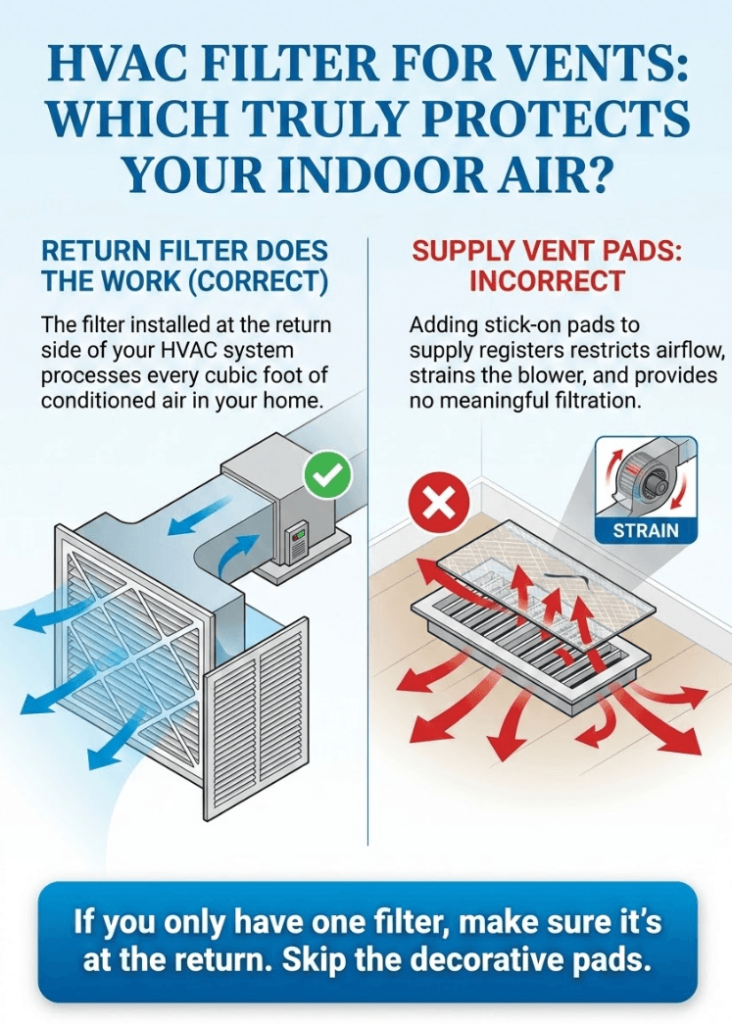
What filter actually protects indoor air? The filter installed at the return side of your HVAC system, not stick-on pads on supply registers. That single filter processes every cubic foot of conditioned air in your home.
What MERV rating should you use? MERV 13. The EPA recommends at least MERV 13 for residential HVAC systems as the indoor defense threshold against fine particles, including PM2.5, wildfire smoke, and common allergens.
Are supply vent filters worth adding? Supply registers are for airflow out. Adding a pad at each one usually restricts output and strains the blower. The return-side filter does the real work.
Is “HEPA-style” the same as HEPA? No. True HEPA captures 99.97% of particles at 0.3 microns. “HEPA-style” is an unregulated marketing label, a filtration concept borrowed without the spec behind it.
Shop MERV 13 Vent Filters at Filterbuy
If you know your return filter size, you can order MERV 13 replacements directly. Before ordering, measure the length, width, and depth printed on the side of your current filter frame.
Top Takeaways
- The return filter does the work. One filter at the return side of your HVAC handles every cubic foot of conditioned air. Supply-register pads are mostly decorative.
- MERV 13 is the EPA’s residential minimum. Below that, fine particles like smoke, pet dander, and PM2.5 cycle through your ducts largely unfiltered.
- “HEPA-style” is not HEPA. True HEPA is a standalone room-purifier tier. If the label says “HEPA-like,” assume it’s closer to MERV 8.
- Outdoor AQI doesn’t tell you what you’re breathing. Indoor air quality depends on what the return filter lets through, not what’s above your roof.
- Airflow still matters. A filter your system can’t pull through is worse than a lower-MERV filter it can.
Table of Contents
How Filters for Vents Actually Protect Your Indoor Air
Every HVAC system pulls room air in through one or more return vents, runs it across the filter, conditions it, and pushes it back out through supply vents. The return-side filter is the single checkpoint. Everything that passes through your ductwork was either small enough to slip past that filter or snuck in through duct leaks downstream.
That’s why the return-side filter matters and the others mostly don’t.
Return Vent Filters vs. Supply Vent Filters: What Belongs Where
Return vents pull air out of the room back toward the air handler. These are the ones that need a real filter. In most homes, the return filter sits either at the air handler itself or behind a large return grille on a wall or ceiling. That grille often holds a filter sized 16×20, 16×25, 20×25, or a similar 1-inch panel.
Supply vents push conditioned air into the room. Adding a pad at each supply register does three things: it restricts airflow at the point of delivery, traps dust on the wrong side of the duct, and strains the blower motor. We’ve pulled supply-vent pads off homes in DeLand and found the ductwork behind them caked in grime because air stopped moving at volume.
If you only have one filter in your home, it’s almost certainly a return filter. Replace that one on a real schedule. Skip the stick-on pads.
MERV 13 Vent Filters: The EPA-Recommended Indoor Defense Threshold
MERV stands for Minimum Efficiency Reporting Value. It rates filters from 1 to 16 on how well they trap particles between 0.3 and 10 microns. A MERV 8 filter (the default in most builder-grade systems) catches most visible dust. A MERV 13 catches dust, pet dander, mold spores, smoke particles, and most virus-carrying droplets.
The EPA recommends at least MERV 13 for home HVAC systems. That’s the residential indoor defense threshold against fine particulates. Go lower and you’re protecting the equipment, not the lungs.
A few field notes:
- Not every system tolerates MERV 13 out of the box. Older blowers and undersized return ducts may struggle with the extra pressure drop. After an upgrade, watch for air starvation symptoms like weak supply-air volume or longer runtimes.
- A 4-inch or 5-inch MERV 13 in a media cabinet runs quieter and lasts longer than a 1-inch MERV 13 in the same slot, because the deeper pleat area reduces resistance.
- If the blower whines or the system short-cycles after you install a MERV 13, step back to MERV 11 and have a tech check static pressure.
Washable, Electrostatic & Dust Filters for Vents: What the Labels Really Mean
Washable vent filters are usually aluminum mesh or foam. They catch large debris like lint and pet hair, and their MERV equivalency sits around 1 to 4. They’re reusable, but they don’t protect indoor air at the fine-particle level. They work as a pre-filter, not as a primary defense.
Electrostatic vent filters come in two flavors. Self-charging polyester panels generate static from airflow and rate around MERV 8 to 10, which makes them a fine mid-tier disposable choice. Powered electronic air cleaners wire into the system and need professional installation. Older models can produce ozone if poorly maintained.
Dust filters for vents is a marketing phrase, not a spec. If the package doesn’t list a MERV number, treat the filter as MERV 4 or below.
Here’s the quick comparison we hand homeowners on service calls:
| Filter Type | Typical MERV | What It Catches | Lifespan | Airflow Impact |
|---|---|---|---|---|
| Fiberglass flat | 1–4 | Large dust, lint | 30 days | Minimal |
| Pleated disposable | 8–11 | Dust, pollen, mold spores | 60–90 days | Moderate |
| MERV 13 pleated | 13 | PM2.5, smoke, dander, fine particles | 60–90 days | Moderate to high |
| Washable mesh | 1–4 | Large debris | Clean monthly | Minimal |
| True HEPA (portable unit) | H13+ (not MERV) | 99.97% of 0.3 µm | 6–12 months | Standalone unit |
The Outdoor-to-Indoor Air Gap
Homeowners check AirNow or a wildfire map, see “Moderate” outside, and assume they’re safe indoors. They aren’t, not automatically. Outdoor AQI tells you what’s in the air above your roof. Your indoor air depends on what gets past the return filter and what’s already circulating inside.
On a Riverside, California wildfire case last fall, outdoor AQI hit “Unhealthy” near 160. Inside one client’s home running a MERV 8 filter, particulate readings climbed to roughly two-thirds of outdoor levels within four hours. In a neighbor’s house running a MERV 13 and a portable HEPA unit in the bedroom, indoor readings stayed near baseline.
Same neighborhood and the same smoke, but the filters were different. That gap is the whole story.
“On every service call, the first filter I pull tells me whether the homeowner thinks of it as dust management or as health protection. Those are not the same job. MERV 13 is the number that closes the gap between them.”
Essential Resources for Choosing the Right Vent Filter
Every resource below comes from a federal agency, a national health organization, or a recognized standards body. Each URL is unique.
1. EPA: Guide to Air Cleaners in the Home
https://www.epa.gov/indoor-air-quality-iaq/guide-air-cleaners-home
The EPA’s consumer-facing guide to portable air cleaners and HVAC filters, with the MERV 13 recommendation called out directly.
2. EPA: Introduction to Indoor Air Quality
https://www.epa.gov/indoor-air-quality-iaq/introduction-indoor-air-quality
Background on indoor pollutants, ventilation, and how filtration fits into the source-control-and-ventilation framework.
3. EPA: Particulate Matter (PM) Basics
https://www.epa.gov/pm-pollution/particulate-matter-pm-basics
Definitions of PM2.5 and PM10, the two particle classes a vent filter either catches or lets through.
4. American Lung Association: Air Cleaning
https://www.lung.org/clean-air/indoor-air/protecting-from-air-pollution/air-cleaning
Health-focused breakdown of HVAC vs. portable air cleaning, including recommended MERV thresholds and where the return filter lives.
5. ENERGY STAR: Heat & Cool Efficiently
https://www.energystar.gov/saveathome/heating-cooling
Filter-change cadence, duct sealing, and system-efficiency guidance from the federal efficiency program.
6. EPA: Sources of Indoor Particulate Matter
https://www.epa.gov/indoor-air-quality-iaq/sources-indoor-particulate-matter-pm
Where indoor particles actually come from: cooking, combustion, outdoor infiltration. That’s the job your filter has to handle day to day.
7. EPA: Air Cleaners, HVAC Filters, and Coronavirus (COVID-19)
https://www.epa.gov/indoor-air-quality-iaq/air-cleaners-hvac-filters-and-coronavirus-covid-19
Guidance on upgrading HVAC filters and using portable cleaners for airborne-infection risk, naming MERV 13 as the minimum for DIY filtration.
Statistics That Explain Why Your Vent Filter Matters
1. Indoor pollutant concentrations can run 2 to 5 times higher than outdoor levels.
The EPA cites its Total Exposure Assessment Methodology studies, which measured indoor levels of about a dozen common organic pollutants at two to five times outdoor concentrations, regardless of whether homes sat in rural or industrial areas.
Source: https://www.epa.gov/report-environment/indoor-air-quality
2. MERV 13 filters capture at least 85% of particles in the 1 to 3 micron range.
The EPA’s MERV guide establishes that a MERV 13 filter captures a minimum of 85% of particles in the 1 to 3 micron size class. That range includes most fine particulate pollution, smoke, and respiratory droplets.
Source: https://www.epa.gov/indoor-air-quality-iaq/what-merv-rating
3. A clean filter can cut HVAC energy consumption by 5 to 15%.
The U.S. Department of Energy reports that routinely replacing or cleaning your air conditioner’s filters can lower energy consumption by 5 to 15 percent. A dirty filter forces the blower to work harder to move the same volume of air, which drives up both utility bills and equipment wear.
Source: https://www.energy.gov/energysaver/air-conditioner-maintenance
Final Thoughts and Opinion
Filter selection isn’t about marketing tiers or package claims. It comes down to one question: what is this filter pulling out of the air before it reaches your family?
MERV 13 is the floor, not the ceiling. Most residential systems built in the last fifteen years can run MERV 13, sometimes with a media-cabinet upgrade. That’s the HVAC filter for vents in home use that actually earns its keep. Filters below MERV 13 protect the equipment from dust buildup. MERV 13 and up protect what your family actually breathes.
One filter, rated correctly and changed on schedule, is the defense.
Frequently Asked Questions
Do I need a filter at every vent in my home?
No. Your return-side filter does the work. Every cubic foot of air your HVAC conditions passes through it first. Adding pads to supply registers usually restricts airflow and doesn’t meaningfully improve filtration.
What MERV rating should my vent filter be?
MERV 13, if your system can handle it. The EPA recommends at least MERV 13 for home HVAC systems. Older or undersized systems may need a 4-inch or 5-inch media cabinet to run MERV 13 without pressure-drop problems.
Are washable vent filters worth it compared to disposable?
Only as a pre-filter. Washable mesh and foam filters catch lint and hair but sit at MERV 1 to 4 territory. They don’t protect indoor air from fine particles. If you use one, pair it with a higher-MERV downstream filter.
How often should I change my return vent filter?
For a 1-inch pleated filter, every 60 to 90 days is the standard cadence. For a 4-inch or 5-inch media filter, every 6 to 12 months. Pets, wildfire smoke events, or ongoing renovation shorten both intervals. Check monthly in summer and winter when the system runs hardest.
Do electrostatic vent filters really work?
Self-charging electrostatic pleated filters work at roughly MERV 8 to 10 efficiency. That’s better than fiberglass but not as strong as MERV 13. Powered electronic air cleaners can perform well, but they need professional installation and maintenance, and some older models produce ozone as a byproduct.
Can a vent filter reduce indoor dust from wildfire smoke?
Yes, if it’s MERV 13 or higher. Wildfire smoke consists mostly of PM2.5. A MERV 13 filter captures most of it. A MERV 8 does not. Run your HVAC fan in “on” rather than “auto” during heavy smoke events to keep air cycling through the filter continuously.
What’s the difference between a return vent filter and a supply vent filter?
The return vent pulls room air back to the air handler, and that’s where the real filter goes. Supply vents push conditioned air into the room. Filtering the supply side traps dust at the wrong point and starves airflow. Focus on the return.
Ready to Upgrade Your Vent Filter?
When your system struggles or your indoor air quality slips, we diagnose what’s actually running the show and get the right filter into the right vent.
Contact Cooling Den to schedule a service call.