

We were on a service call in Lancaster County last June when the sky turned flat copper-yellow by 10 in the morning. The homeowner had checked a wildfire map on her phone and saw nothing burning nearby. She had no reason to think smoke was the problem.
What she didn’t know was that fires burning hundreds of miles north had been pushing smoke southeast since the night before. Her HVAC system was running on a MERV 8 filter, pulling that air straight through. Outdoor smoke maps track where smoke sits in the atmosphere. They don’t tell you what’s getting inside your home. One thing determines that gap: the filter rating in your heating and cooling system.
Pennsylvania has been on the receiving end of Canadian and Midwestern wildfire smoke more often than most residents realize. This page covers where smoke is tracking today, which counties face the most exposure, and what a MERV upgrade actually does to the air inside your house.
TL;DR Quick Answers
Check the Live PA Wildfire & Smoke Map — Updated Today
- Is there wildfire smoke in Pennsylvania today? Check the AirNow fire and smoke map for your county’s current AQI. Readings update hourly. An AQI above 100 means sensitive groups should stay indoors; above 150 means everyone should limit outdoor exposure.
- Where is the smoke coming from? Most smoke affecting Pennsylvania originates from fires in Canada, the Midwest, or the Mid-Atlantic region. Wildfire smoke travels at altitude and can cover more than 1,000 miles before descending into PA valleys and population centers.
- My outdoor AQI looks fine — is my indoor air safe? Not necessarily. Outdoor AQI measures what’s in the air outside. Your HVAC filter determines how much of that smoke enters your home. A standard MERV 8 filter captures fewer than 20 percent of PM2.5 wildfire smoke particles.
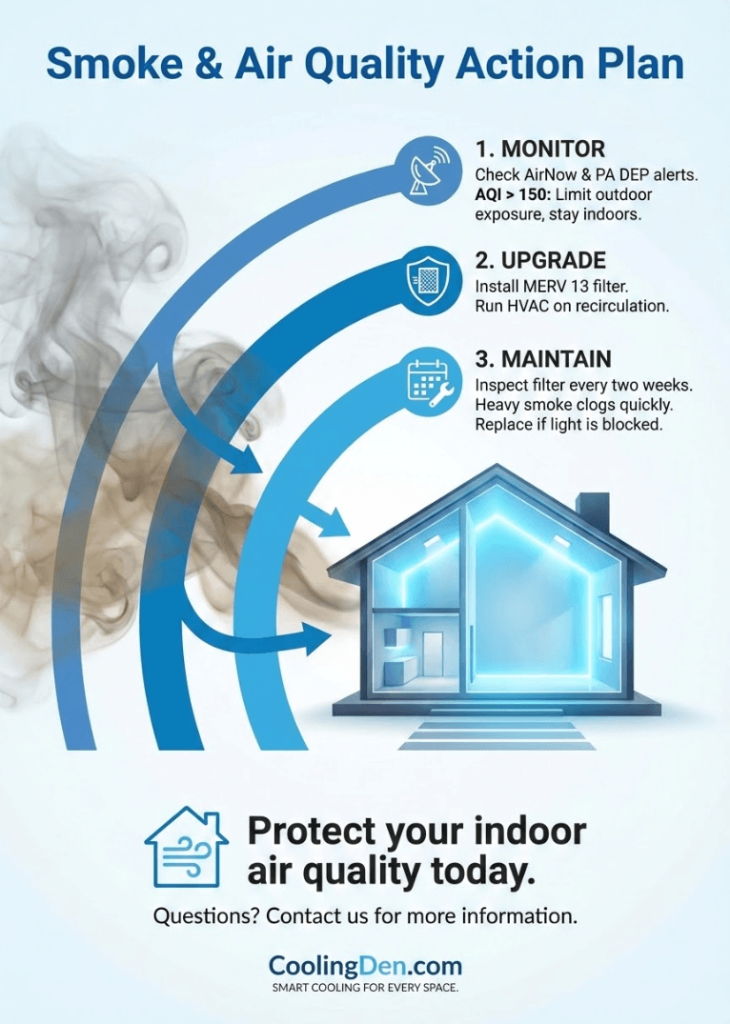
- What MERV rating do I need for wildfire smoke? The EPA recommends MERV 13 as the minimum effective rating for capturing fine particulate matter from wildfire smoke. Most residential systems ship with MERV 8, which isn’t built for smoke events. For a practical look at how filter selection affects both air quality and system performance, the guide on best air filters for balanced air quality and HVAC performance covers the key tradeoffs.
- How often should I change my filter during a PA smoke advisory? During active advisories, inspect your filter every two weeks. Heavy smoke loads a filter in half the normal cycle. If the filter face is uniformly gray or brown and light won’t pass through the media, replace it now.
Top Takeaways
- Wildfire smoke affecting Pennsylvania most often originates from Canadian or Midwestern fires, not local burns. A major fire event can push smoke more than 1,000 miles before it reaches PA counties.
- Outdoor AQI maps don’t measure indoor air quality. Your filter rating determines how much PM2.5 enters your home — outdoor conditions and indoor conditions aren’t the same number.
- MERV 13 is the EPA-recommended minimum for filtering wildfire smoke particles. Standard MERV 8 filters capture fewer than 20 percent of particles in the fine PM2.5 range.
- Counties along Pennsylvania’s major river corridors — the Susquehanna, Delaware, and Allegheny basins — tend to see higher smoke concentrations during drift events because terrain channels incoming plumes.
- An AQI above 150 is unhealthy for all residents, not just sensitive groups. Stay indoors, close the windows, and run the HVAC on recirculation mode.
- A dirty filter during a smoke event makes your system work harder and distributes dirtier air. Check filters every two weeks when advisories are active.
- PA DEP issues Air Quality Action Days by county. Sign up at dep.pa.gov to get same-day notifications when smoke advisory thresholds are crossed in your area.
Table of Contents
How Wildfire Smoke Reaches Pennsylvania — and What to Do About It
How Wildfire Smoke Moves Across Pennsylvania
Pennsylvania sits where several major air mass corridors converge. Prevailing westerly winds carry smoke from fires in Canada, the upper Midwest, and even the Pacific Northwest across the Great Lakes before it reaches the Mid-Atlantic. The Appalachian Mountains don’t stop this movement. In many cases, they concentrate it. Smoke funnels along river valleys and pools in lower elevations overnight, which means communities along the Susquehanna and Delaware corridors can wake up to sharp AQI spikes with no local fire burning anywhere nearby.
The June 2023 Canadian wildfire event showed exactly how fast this happens in Pennsylvania. AQI readings across much of the state climbed above 200 — into the Very Unhealthy and Hazardous categories — within hours. Pittsburgh, Philadelphia, Harrisburg, and Allentown all recorded readings that exceeded safe thresholds for healthy adults. That scale of event is no longer unusual. Climate patterns have extended wildfire season and widened the geographic footprint of smoke transport across the Northeast.
What Outdoor AQI Does Not Tell You Indoors
Outdoor AQI measures what’s in the air outside. It tells you nothing about what’s happening inside.
The variable that determines indoor air quality during a smoke event is the HVAC filter. When PM2.5 particles — fine particulate matter at 2.5 microns or smaller — are present in outdoor air, they work through building envelope gaps and HVAC intake paths. A MERV 8 filter, which most residential systems run by default, captures fewer than 20 percent of particles in the PM2.5 size range. A MERV 13 filter captures at least 50 percent of those particles in the finest size range and 85 percent or more in the middle range.
The EPA’s guidance on wildfire smoke and indoor air quality is direct: upgrade to MERV 13 during smoke events if your system supports it. If your system was installed before 2015 or hasn’t been assessed for higher-MERV compatibility, have a technician confirm the upgrade is safe first. The question of whether a higher-MERV filter will restrict airflow in older systems is worth answering before you upgrade — a filter with too much resistance can strain older equipment.
PA Counties Most Exposed to Smoke Drift
We’ve seen smoke concentration vary significantly across Pennsylvania on the same weather day. Allegheny County and the Pittsburgh metro tend to catch smoke from western and northwestern sources due to prevailing wind direction. The Lehigh Valley and Philadelphia suburbs receive smoke that has crossed the Delaware Valley and concentrated along the coastal plain. Lancaster and York counties sit on flat agricultural terrain with little topographic disruption, which puts them directly in the path of incoming plumes.
Erie County gets a different pattern. Lake-effect air circulation can trap smoke at lower altitudes for extended periods. Centre County and the Susquehanna headwaters region see terrain-driven concentration overnight, with smoke clearing later in the morning than in urban areas. During a significant regional event, no PA county escapes.
When to Change Your Filter During a Smoke Event
The standard 60-to-90-day replacement schedule doesn’t hold during smoke events. A MERV 13 filter running through a week-long smoke advisory can approach full loading in a fraction of a normal cycle. We tell homeowners to pull the filter and hold it up to a light source. If the face is uniformly gray or brown and light won’t pass through the media, replace it now — not at the end of the month. A MERV 8 pleated furnace filter 4-pack is a practical baseline replacement to have on hand before an advisory hits.
Running an overloaded filter doesn’t produce cleaner air. It makes your system work harder to push air through a clogged barrier, which strains the blower motor and cuts the volume of filtered air circulating through your home. Check the filter every two weeks when smoke advisories are active in your county.
“On a call in York County during the 2023 Canadian smoke event, we pulled a MERV 8 filter that had been in service for six weeks — still pale gray, which told us the system was passing most of those PM2.5 particles straight through rather than capturing them. If outdoor smoke is reading Unhealthy on AirNow and your home filter is still clean, that’s not good news — it means your filter isn’t doing the job.”
7 Essential Resources
Track Real-Time Wildfire Smoke Across Pennsylvania
AirNow’s Fire and Smoke Map is the federal government’s primary real-time tool for tracking wildfire smoke across the US. The map updates hourly and shows AQI readings by county alongside active fire locations, smoke plume positions, and air quality forecasts. Pennsylvania residents can check whether their county is currently under an air quality alert and what conditions are forecast over the next 24 hours. For current PA smoke drift, this is the most reliable source available.
Source: AirNow
Pennsylvania’s Official Air Quality Alert System
The Pennsylvania Department of Environmental Protection runs a statewide air quality monitoring network covering all major population centers and many rural counties. The DEP issues Air Quality Action Days when pollutant concentrations — including PM2.5 from wildfire smoke — are forecast to hit unhealthy levels. Residents and healthcare providers can check county-level conditions and sign up for email alerts through the DEP air quality portal.
Source: Pennsylvania DEP
How Wildfire Smoke Enters Your Home and What to Do About It
The EPA’s indoor air quality wildfire guide explains how PM2.5 particles from outdoor smoke penetrate homes, what household factors make infiltration worse, and which protective measures work. The guide covers HVAC filter upgrades, portable air cleaners, and ventilation strategies for cutting smoke exposure indoors. It also explains the gap between outdoor AQI readings and actual indoor air quality — the disconnect that catches most homeowners off guard during smoke events.
Source: EPA
The Industry Standard Behind Every MERV Rating on Your Filter
ASHRAE Standard 52.2 defines how air filters earn their MERV ratings for particle capture efficiency. The scale runs from 1 to 16 in residential and commercial applications. MERV 13 is where a filter starts meaningfully capturing PM2.5 particles, including wildfire smoke. Knowing what each rating actually captures — and what it doesn’t — helps homeowners make informed decisions before a smoke event hits.
Source: ASHRAE
Active Fire Locations and Annual Fire Statistics
NIFC coordinates all wildfire activity across the United States and publishes active fire locations, total acreage burned, and year-over-year comparisons for fire activity nationally. For Pennsylvania residents, NIFC data is most useful during Canadian or Midwestern fire events — it shows where active fires are burning and explains why smoke is drifting into the Northeast.
Source: National Interagency Fire Center
Health Effects of Wildfire Smoke Exposure by Population Group
The CDC’s air quality and health resource explains how wildfire smoke affects different populations — children, older adults, pregnant women, and people with cardiovascular or respiratory conditions — and what symptoms to watch for during exposure events. The CDC separates short-term from long-term exposure effects and gives guidance on when to seek medical attention.
Source: CDC
Improving Indoor Air Quality During Smoke Events
ENERGY STAR’s indoor air quality guidance covers how heating and cooling systems interact with outdoor air quality and what homeowners should do to get the most from their HVAC during smoke conditions. The resource addresses filter selection, system maintenance, and ventilation controls that limit smoke infiltration. It also explains why running an HVAC on recirculation mode is the right call during smoke advisories.
Source: ENERGY STAR
3 Statistics
Wildfire Smoke Accounts for More Than 25 Percent of Annual Fine Particle Pollution in the U.S.
EPA research and wildfire smoke training materials show that wildfire smoke can account for more than 25 percent of total fine particle (PM2.5) pollution in the United States in any given year. During peak fire seasons — especially years with active Canadian fire events — that contribution spikes well above the annual average across the Northeast, including Pennsylvania, for weeks at a time. PM2.5 is the pollutant most directly tied to respiratory and cardiovascular health impacts during smoke events. It’s also the particle size that standard MERV 8 residential filters are least equipped to capture.
Source: EPA Wildfire Smoke Course
2023 Canadian Wildfires Burned Over 18 Million Acres and Pushed PA AQI Above 200
The National Interagency Fire Center documented the 2023 Canadian wildfire season as among the most destructive on record, with more than 18 million acres burned — more than double any previous recorded Canadian season. Smoke plumes from those fires traveled thousands of miles south and east, pushing AQI readings above 200 across Pennsylvania, New York, and much of the Mid-Atlantic in June 2023. NIFC’s annual statistics pages track active fire locations, acreage, and historical comparisons in real time.
Source: NIFC Fire Statistics
MERV 13 Filters Capture at Least 50 Percent More Fine Particles Than MERV 8 in the PM2.5 Range
EPA guidance on MERV ratings states that MERV 13 filters capture at least 50 percent of airborne particles in the 0.3 to 1.0 micron size range — the range that includes the finest PM2.5 wildfire smoke particles — and 85 percent or more of particles in the 1.0 to 3.0 micron range. MERV 8 filters capture fewer than 20 percent of particles in that finest size bracket. Upgrading to MERV 13 is the single most impactful step a homeowner can take to reduce indoor smoke exposure.
Source: EPA — What Is a MERV Rating?
Final Thoughts
Wildfire smoke in Pennsylvania is no longer a seasonal news event. It’s a service-call reality. We’ve pulled filters in homes across York, Lancaster, and Allegheny counties during smoke events and seen what an unprotected HVAC system does with that air: it circulates it.
Outdoor AQI maps show you part of the story. Your HVAC filter writes the rest. MERV 13 is where the EPA draws the line on meaningful protection. If your system is running anything lower when the next smoke advisory hits Pennsylvania, you’ll know before the week is out that the filter wasn’t rated for it. Stocking a MERV 8 Dust Defense pleated HVAC filter as a baseline replacement — and scheduling a seasonal HVAC tune-up before smoke season — keeps the system ready before conditions deteriorate.
Frequently Asked Questions
Is there wildfire smoke in Pennsylvania today?
Check AirNow’s fire and smoke map at airnow.gov for real-time AQI readings by county. Conditions update hourly. A reading above 100 is the threshold for limiting outdoor activity for sensitive groups; above 150 means all residents should take protective action indoors.
Where is smoke drifting in Pennsylvania right now?
Most smoke affecting PA originates from Canadian, Midwestern, or Mid-Atlantic fires. Prevailing westerly winds carry plumes across the Great Lakes and push them southeast into Pennsylvania, where they concentrate in river valleys and lower terrain overnight.
What counties in PA are most affected by wildfire smoke?
Allegheny, Philadelphia, Lancaster, York, and Lehigh counties tend to see the highest concentrations during large smoke events, driven by prevailing wind paths and terrain. Erie County sees lake-influenced patterns that extend exposure periods beyond what the rest of the state typically experiences.
What AQI level is dangerous for Pennsylvania residents?
An AQI above 100 is unhealthy for sensitive groups — children, elderly adults, and people with heart or lung conditions. Above 150 is unhealthy for everyone. Above 200 is classified Very Unhealthy and requires immediate indoor protective action for all residents.
Does my HVAC filter protect me from wildfire smoke?
That depends on the MERV rating. A MERV 8 filter captures fewer than 20 percent of PM2.5 wildfire smoke particles, which means most of what’s in outdoor smoke passes through and recirculates indoors. A MERV 13 captures 50 percent or more of the finest particles and provides real protection when your system is running. Replacement MERV 8 Dust Defense pleated furnace filter 4-packs are widely available for standard residential air handler sizes. For sizing or compatibility questions, HVAC maintenance companies can confirm which MERV rating your system can handle before you upgrade.
Can wildfire smoke from Canada reach Pennsylvania?
Yes, and June 2023 confirmed it. Canadian wildfire smoke drove PA AQI readings above 200 in multiple counties that month. Wildfire smoke travels at altitude and can cover more than 1,000 miles before it descends to ground level.
How often should I change my filter during a smoke advisory?
Inspect the filter every two weeks instead of following your standard schedule. If the face is uniformly gray or brown and light won’t pass through the media, replace it immediately. A loaded filter cuts airflow and stops capturing particles. For replacements, a MERV 8 Dust Defense pleated HVAC filter 4-pack is available at Target, and a pleated MERV 8 AC filter replacement is available on eBay for comparison pricing.
What is the difference between outdoor AQI and indoor air quality?
Outdoor AQI measures pollutant concentration outside. Indoor air quality depends on how much of that outdoor air enters your home and what your HVAC filter captures. A high outdoor AQI doesn’t guarantee bad indoor air if you’re running a clean MERV 13. A low outdoor AQI doesn’t guarantee good indoor air if your filter is overloaded or under-rated for smoke.
Protect Indoor Air While Smoke Drifts Across PA
Wildfire smoke reaching Pennsylvania this season will find its way indoors through every HVAC system running a standard MERV 8 filter. The EPA sets MERV 13 as the minimum threshold for meaningful smoke particle capture. Check current wildfire and smoke filter options for Pennsylvania — sized for your system and ready to ship.