

The dehumidifier filter is the one we find clogged the most. Not the HVAC filter — homeowners know to change that one. The dehumidifier filter sits behind the front grille, collects dust every time the unit runs, and most homeowners never touch it.
We’ve seen this pattern on hundreds of service calls across Florida. Homeowners changing their HVAC filter every 30 days, running a humidifier through dry spells, and still dealing with musty odors, humidity that won’t come down, and air that never quite feels right. The missing piece is almost always the dehumidifier air filter — clogged, ignored, quietly working against everything else in the system.
Your HVAC filter, humidifier, and dehumidifier don’t operate independently. When one falls behind, the others feel it. Below, we cover what that relationship actually looks like, what your dehumidifier filter replacement schedule should be in Florida’s climate, and how to keep all three components working the way they’re supposed to.
TL;DR Quick Answers
- What is a dehumidifier air filter? A washable mesh or foam screen inside the unit that captures dust and particles before air passes over the cooling coil.
- Dehumidifier filter replacement schedule: Inspect monthly; rinse or replace every 1–3 months. In humid climates like Florida, lean toward monthly.
- Are filters for dehumidifiers the same as HVAC filters? No — they’re unit-specific and serve different functions. Don’t substitute one for the other.
- Best humidity target: 30–50% relative humidity year-round. Florida homes should hold 40–50%.
- What happens when the dehumidifier air filter clogs? Moisture removal drops, the motor works harder, and semi-filtered air circulates back through your HVAC system.
- Best HVAC filter pairing: MERV 11–13, combined with a clean dehumidifier filter, gives most homes the most complete indoor air coverage.
Top Takeaways
- The dehumidifier air filter is the most skipped maintenance item we see. A clogged one is behind more moisture and odor complaints than most homeowners expect.
- Dehumidifier filters and HVAC filters work as a team. Neglect one, and the other works harder and wears out faster.
- Uncontrolled humidity loads HVAC filters faster. Excess moisture and weak filtration reinforce each other.
- Monthly inspection is the right standard in Florida, not quarterly. High runtime means faster filter loading.
- MERV 11–13 is the right HVAC pairing for most homes running a dehumidifier — effective particle capture without restricting airflow on standard systems.
- Humidity control is the foundation. No filter upgrade fully compensates for moisture that’s out of range.
Table of Contents
What Is a Dehumidifier Air Filter — and Why Does It Matter?
A dehumidifier pulls moisture from the air by drawing it across a refrigerated coil. Before that air reaches the coil, it passes through a filter. That filter catches dust, pet dander, mold spores, and fine particles, keeping them off the coil and out of the unit’s internal components.
Most filters for dehumidifiers are simple washable mesh or foam. They’re inexpensive. And they’re almost universally ignored. In our experience servicing HVAC systems across Florida, a clogged dehumidifier filter is one of the first things we check when homeowners report persistent humidity problems, musty odors, or a unit that runs constantly without results.
When the filter clogs, a few things happen at once: airflow to the coil drops, moisture removal efficiency falls, particles bypass the blocked media and build up on the coil, and the air the unit expels circulates semi-filtered back through your home. We’ve been on service calls where homeowners had changed their HVAC filter every 30 days for over a year and hadn’t touched the dehumidifier filter once. The system was fighting itself.
Dehumidifier Filter Replacement: Schedule and How to Do It
Inspect the filter monthly. Replace or rinse it every one to three months. In Florida’s climate, we lean toward the shorter end of that range — high ambient humidity means the unit runs more, processes more air, and loads the filter faster than it would in a drier climate.
Signs the filter needs attention:
- Visible dust or gray discoloration on the filter media
- Musty odor coming from the unit during operation
- The unit runs constantly but indoor humidity stays elevated
- Increased particulate settling on surfaces near the unit
How to replace or rinse it:
- Unplug the unit before touching any internal component.
- Locate the filter — typically behind the front grille on most home dehumidifiers.
- Remove and inspect: if washable, rinse with cold water and let it dry fully before reinstalling; if disposable, replace with an exact-spec match for your model.
- Check the coil for dust buildup before putting the filter back.
- Reinstall, plug the unit in, and watch humidity readings over the next 24 hours.
Replacement filters for dehumidifiers need to match the original spec exactly. An off-size or incompatible air filter for a dehumidifier creates bypass gaps that let unfiltered air reach the coil, which defeats the filter’s entire purpose.
How HVAC Filters and Home Dehumidifier Filters Work Together
Your HVAC filter handles particles in the whole-home air cycle. Your dehumidifier air filter cleans the air the unit processes to extract moisture. Neither covers the other’s job. And both fail faster when the other gets ignored.
Here’s what that looks like in practice: excess humidity causes fine particles to settle on surfaces rather than staying airborne, but when humidity levels fluctuate, those particles re-enter the air stream and load your HVAC filter faster than normal. A clogged HVAC filter restricts airflow, which makes it harder for the system to circulate and condition air efficiently, which in turn raises indoor humidity. A dirty dehumidifier air filter means the unit pushes partially filtered air back into the space your HVAC system then has to process all over again.
For most Florida homes, a MERV 11–13 HVAC filter paired with a clean dehumidifier filter, with humidity held at 40–50%, is the setup that performs best. When both filters stay on schedule, the equipment runs fewer hours, energy use drops, and the improvement shows up in how the house actually feels.
“After years of opening return vents and dehumidifier grilles in homes across Florida, the pattern doesn’t change: the homes with the cleanest air and the lowest energy bills aren’t the ones with the most expensive equipment — they’re the ones where every filter in the system gets maintained on schedule. The dehumidifier air filter is the one that gets skipped. When we track down the root cause of moisture complaints, musty odors, or a unit that runs nonstop without results, a clogged or degraded dehumidifier filter is the answer more often than not. Maintaining filters for dehumidifiers isn’t optional maintenance — it’s the maintenance most homeowners wish they’d started sooner.”
7 Essential Resources
1. EPA Indoor Air Quality Guide
The EPA’s indoor air quality framework establishes the 30–50% humidity standard at the center of responsible moisture management in any home. It explains how filtration, ventilation, and humidity control function as a connected system — which maps directly to what we see in the field when all three are neglected at once. Homeowners who read this before buying any equipment start with the right framework instead of patching the wrong problem.
Source: U.S. Environmental Protection Agency, Care for Your Air: A Guide to Indoor Air Quality
2. EPA Mold and Moisture Guide
Mold doesn’t wait for spring. In Florida’s climate, it doesn’t wait at all. We’ve been on service calls where mold was growing inside return-vent covers and along ductwork walls, all traced back to a dehumidifier that stopped pulling moisture effectively because the air filter was completely blocked. The EPA’s mold guide explains exactly how indoor moisture problems develop, where they concentrate, and what stops them before they reach the ductwork. Read it and dehumidifier filter maintenance stops looking like an appliance chore.
Source: U.S. Environmental Protection Agency, A Brief Guide to Mold, Moisture and Your Home
3. ASHRAE Filtration and Disinfection FAQ
The most common filter mistake we see in the field isn’t choosing too low a MERV rating — it’s choosing one that’s too high for the system’s airflow capacity. ASHRAE, the organization that created the MERV rating system, breaks down precisely what each rating captures, what particle sizes matter most in residential settings, and why matching the filter to the system’s design capacity matters more than grabbing the highest number on the shelf. We point homeowners here before any MERV upgrade. A MERV 13 in a system built for MERV 8 restricts airflow the same way a dirty filter does, and we’ve seen both on the same service call.
4. Mayo Clinic Humidifier Guide
Humidifiers solve real problems when indoor humidity falls below 30% — dry skin, sinus irritation, cracked wood, persistent static. They also create real problems when the unit doesn’t get cleaned. Mayo Clinic’s guide covers both sides: when humidifier use genuinely helps, and when poor maintenance turns the unit into a source of airborne bacteria and mold. We recommend this to every homeowner running a portable or whole-home humidifier, especially before running one through an extended stretch of dry weather.
Source: Mayo Clinic, Humidifiers: Air Moisture Eases Skin and Breathing Symptoms
5. CDC Mold Guidance
The CDC’s mold prevention guidance connects directly to what we find when dehumidifier filter replacement gets delayed too long. Moisture that goes unchecked feeds mold growth in places that stay invisible until the problem is already serious — inside wall cavities, behind baseboards, in ductwork bends, around coil housings. This resource helps homeowners understand the health stakes behind what looks like a routine filter swap. A $15 filter decision is often a decision about whether mold gets a foothold in the home’s HVAC infrastructure.
Source: Centers for Disease Control and Prevention, Mold
6. ENERGY STAR Heat and Cool Efficiently
Clean filters — HVAC and dehumidifier — use measurably less energy. ENERGY STAR’s guide covers practical efficiency strategies, filter inspection schedules, and maintenance benchmarks that apply directly to homes running dehumidifiers alongside central air. When homeowners ask us whether consistent filter maintenance actually saves money, this is where the documented numbers are.
Source: ENERGY STAR, Heat and Cool Efficiently
7. Department of Energy: Improving Duct System Performance
No filter upgrade fully compensates for leaky ductwork. We’ve serviced homes with a MERV 13 installed and a recently cleaned dehumidifier filter, and air quality still lagged because conditioned air was bypassing the system through duct gaps. The DOE’s resource on duct system performance explains why duct integrity is a prerequisite for real air quality and efficiency gains, and what a professional duct inspection should cover. Better filters only solve part of the problem if the delivery infrastructure is compromised.
Source: U.S. Department of Energy, Improving Duct System Performance
3 Supporting Statistics
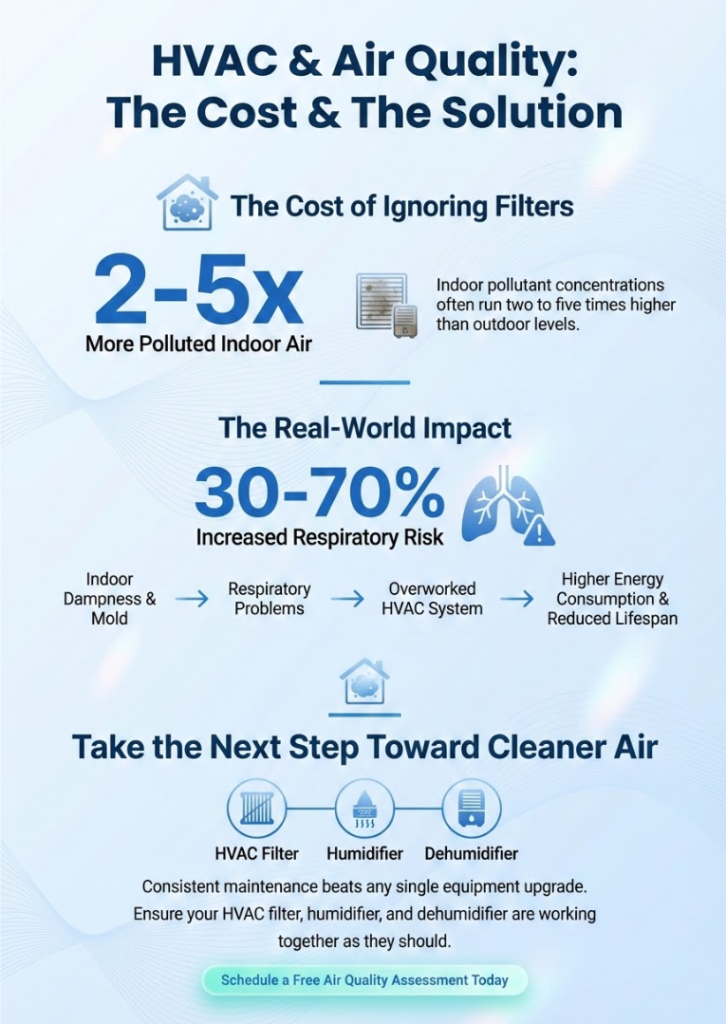
Indoor Air Is Often 2–5x More Polluted Than Outdoor Air
Americans spend roughly 90% of their time indoors, and the EPA has documented that indoor pollutant concentrations run two to five times higher than outdoor levels in many homes. That number isn’t abstract to us — we see it in the filter media on every service visit. The homes with the worst readings almost always share one factor: a dehumidifier air filter that’s been concentrating and recirculating indoor contaminants for months while the homeowner assumed the HVAC filter was handling everything.
Source: U.S. Environmental Protection Agency, Indoor Air Quality
Indoor Dampness and Mold Are Linked to a 30–50% Increase in Respiratory Health Problems
Research from Lawrence Berkeley National Laboratory found that indoor dampness and mold are associated with a 30–70% increase in respiratory health problems, and that roughly 21% of current U.S. asthma cases are estimated to be attributable to dampness and mold exposure at home. We see the downstream effects on every service visit to a home with uncontrolled humidity: HVAC filters loading weeks ahead of schedule, musty odors in the ductwork, coil surfaces showing mold accumulation that traces back to a dehumidifier filter that hadn’t been serviced in months.
Poorly Maintained HVAC Systems Use Significantly More Energy
The U.S. Department of Energy reports that heating and cooling account for nearly half of the energy use in a typical U.S. home, and that dirty or clogged filters are among the leading causes of unnecessary energy consumption and premature equipment failure. We see this on every call where both the HVAC filter and the dehumidifier air filter have been skipped. The system compensates for restricted airflow by running longer cycles, driving up energy bills before any mechanical failure shows up. Keeping both filters on schedule is one of the highest-return, lowest-cost maintenance habits a homeowner can build.
Source: U.S. Department of Energy, Heating and Cooling
Final Thoughts and Opinion
Most dehumidifier filter problems aren’t complicated. They’re just skipped.
After years of servicing HVAC systems and responding to indoor air quality calls across Florida, we can tell you the homes with the cleanest air and the most efficient equipment share one habit: they maintain every filter in the system, not just the one in the air handler. The dehumidifier air filter is part of that system and deserves to be treated as one.
The homeowners who get lasting results aren’t the ones who bought the most expensive equipment. They’re the ones who understood the connection between humidity and filtration early, built a monthly maintenance habit around both, and stopped treating the dehumidifier as a standalone appliance that takes care of itself.
Our recommendation: set a monthly reminder. Rinse or replace the dehumidifier filter on schedule. Pair it with a MERV 11–13 HVAC filter suited to your system. Hold indoor humidity between 40–50% in Florida conditions. Consistent maintenance beats any single equipment upgrade, every time.
If you’re not sure whether your current setup is performing the way it should, that’s exactly the kind of question we can answer on a service call. We’d rather help you tune what you have than sell you something you don’t need.
Frequently Asked Questions
What is a dehumidifier air filter?
A dehumidifier air filter is a mesh or foam screen built into the unit that captures dust, pet dander, and airborne particles before air passes over the cooling coil. Most dehumidifier filters are washable and reusable, but they still need regular cleaning or replacement to maintain moisture removal efficiency and protect the coil from buildup.
How often should I replace my dehumidifier filter?
Inspect monthly and rinse or replace every one to three months. In Florida’s climate, monthly inspection is the practical standard — the unit runs more hours here, which loads the filter faster. Don’t wait for the unit to show obvious performance problems; by then, the filter has been compromised for a while.
Can I use any air filter in a dehumidifier?
No. Filters for dehumidifiers are unit-specific and sized for each model’s internal airflow path. An off-spec or wrong-size replacement creates bypass gaps that let unfiltered air reach the coil directly. Match the replacement to your unit’s exact model specs — printed on the original filter frame or in the owner’s manual.
How do HVAC filters and dehumidifier filters work together?
Your HVAC filter captures particles in the whole-home air cycle. Your dehumidifier air filter cleans the air the unit processes to remove moisture. When both stay maintained, the system runs efficiently and air quality improves consistently. When either falls behind, it increases the load on the other — dirty filters in either unit create compounding strain that shortens equipment life and raises energy costs.
What MERV rating should I pair with a home dehumidifier?
For most Florida homes running a dehumidifier, MERV 11–13 is the right HVAC complement. MERV 11 handles most particle loads without restricting airflow on standard residential systems. MERV 13 is appropriate for allergy sufferers or pet households, if the HVAC system is rated for it. Not sure what your system can handle? Ask your HVAC technician before going above MERV 11.
Does humidity level affect how fast my HVAC filter gets dirty?
Yes, directly. Excess indoor humidity causes airborne particles to settle faster, but fluctuating humidity levels repeatedly push those particles back into the air stream. Homes with uncontrolled humidity load HVAC filters measurably faster than homes holding steady at 40–50%. Controlling humidity with a properly maintained dehumidifier is one of the most effective ways to extend HVAC filter life.
Take the Next Step Toward Cleaner Indoor Air
Knowing what your filters should do is useful. Having a technician confirm your system is actually doing it makes the difference.
Our certified HVAC technicians have serviced systems across Florida and can assess whether your HVAC filter, dehumidifier air filter, and humidity control are working together the way they should. If something’s off, we’ll tell you what it is and what it takes to fix it — straight.
Schedule a free filter and air quality assessment today.
For HVAC filter sizing and MERV selection, we recommend starting with the resources at Filterbuy, whose team has put together one of the most thorough guides available on pairing the right filter with the right system for your specific air quality needs and climate conditions.