
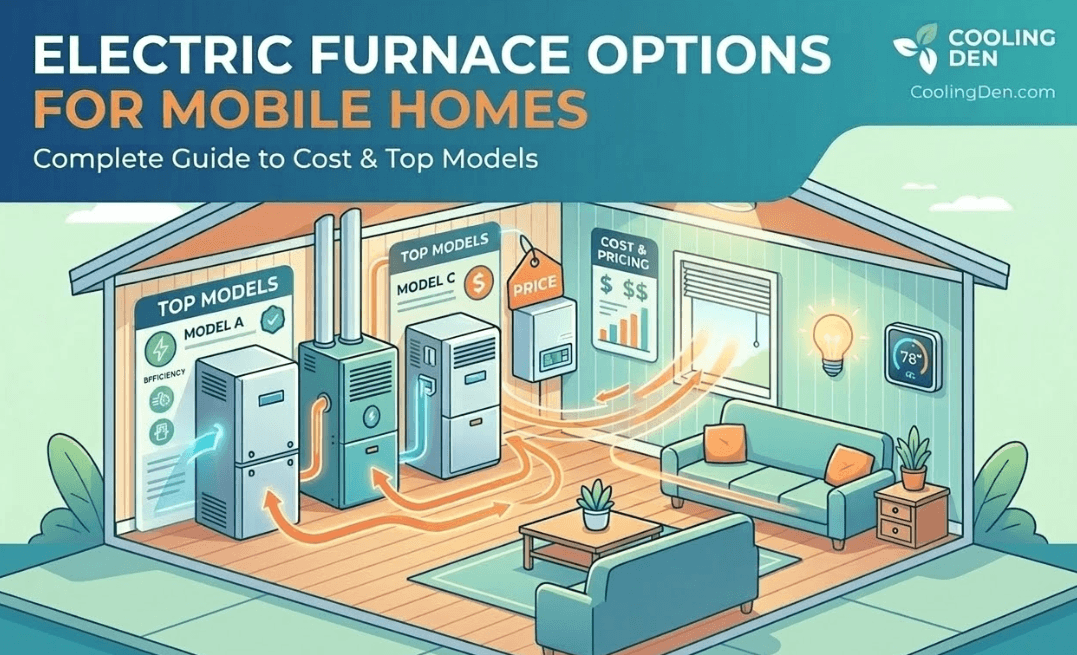
Most homeowners searching for electric furnaces for mobile homes hit the same wall: generic results built for site-built houses that do not apply to manufactured housing at all. Wrong clearances. Wrong duct configurations. Wrong assumptions. We have seen it firsthand on service calls across Florida, and it costs homeowners both time and money.
Mobile homes require furnaces built to HUD code standards, sized for compact duct systems, and installed within tighter spatial constraints than a conventional home will ever demand. At CoolingDen, we work directly with manufactured housing owners who need straight answers, not repurposed advice from a standard HVAC guide.
This page gives you what we know from the field: real cost ranges, the models that consistently hold up, and the spec details that actually matter before you buy or replace. If you want to make a confident, informed decision without starting over three times, you are in the right place.
TL;DR Quick Answers
Electric Furnace Options for Mobile Homes
An electric furnace for a mobile home must be HUD-listed and specifically rated for manufactured housing. Standard residential units do not qualify.
Top HUD-listed options:
- Goodman MBVK Series
- Intertherm E-Series
- Ducane Electric Furnaces
Key facts:
- Unit cost: $500 to $1,500
- Installed cost: $1,000 to $4,800
- Sizing range: 10 to 20 kW depending on home size
- Configuration: Most mobile homes require a downflow unit
- Compliance: Must meet HUD Manufactured Home Construction and Safety Standards
Before you buy:
- Confirm HUD listing status
- Measure your utility closet opening
- Get a professional load calculation
- Inspect your electrical panel capacity
Electric furnaces are the most practical heating choice for Florida manufactured home owners — no gas infrastructure required, no combustion risk, and lower maintenance than gas alternatives.
Top Takeaways
- HUD compliance is non-negotiable. A standard residential unit does not meet code. The furnace must be specifically listed for manufactured housing — regardless of brand or price.
- Electric is the practical choice for most Florida manufactured home owners. No gas infrastructure. No combustion risk. No flue pipe. Lower maintenance. Right-sized for mild-winter climates.
- Sizing and panel capacity matter as much as the unit itself. A load calculation and airpanel inspection are required before installation. Mobile home panels are already working harder than most other housing types.
- Measure before you buy. Cabinet width, airflow direction, and duct flange alignment are manufactured housing-specific. Two inches too wide means structural modification.
- Budget for the full installed cost from the start. Factor in:
- Unit cost
- Installation labor
- Electrical upgrades if needed
- Ductwork modifications if needed
Do not discover these costs after the unit arrives.
Table of Contents
Why Mobile Homes Require a Different Kind of Electric Furnace
Not every furnace on the market can legally or safely go into a mobile or manufactured home. Standard residential units fail inspection, create clearance problems, or simply do not connect to the existing duct layout. Mobile home furnaces must be HUD-certified with smaller cabinets, specific clearances, and ductwork connections built for under-floor duct systems. The distinction matters most in three places: cabinet width, airflow direction, and the base connection to under-floor ducts. Get those right and the rest of the selection process becomes straightforward.
Electric vs. Gas: Why Electric Wins in Most Mobile Homes
Electric is simpler, safer, and better matched to the infrastructure most mobile homes already have. No combustion byproducts, no carbon monoxide risk, no flue pipe, no gas line. Installation requires only an adequate electrical supply, proper duct connections, and HUD compliance. In Florida, where heating demand is limited, the operating cost difference between electric and gas rarely justifies the added complexity of a gas system.
HUD Code Compliance: What It Means and Why It Cannot Be Skipped
Any replacement furnace must be listed for use in a manufactured home. This is a legal requirement. HUD standards govern safety features, clearance minimums, cabinet configuration, duct connection style, and required electrical circuits. Always confirm HUD listing status before purchasing. If a supplier cannot provide documentation that a model is listed for manufactured housing, keep looking.
How to Size an Electric Furnace for a Mobile Home
Oversizing causes short cycling and blower wear. Undersizing leaves rooms cold. Electric furnaces are rated in kilowatts, with roughly 3,412 BTU per kilowatt of output. From our experience with Florida manufactured housing, single-wides in the 800 to 1,200 square foot range typically need 10 to 15 kW. Double-wides generally call for 15 to 20 kW depending on insulation and window count. Always have a professional perform a load calculation before finalizing your choice.
Top Electric Furnace Models for Mobile Homes
Goodman MBVK Series — Consistent performer with built-in overheat protection, sequencers to stagger power draw, and a 10-year limited parts warranty. Broad parts availability makes service quick and affordable.
Intertherm E-Series — The category leader for manufactured housing. Tight-pack components fit narrow utility closets, and the E-Series downflow units are a reliable direct replacement for many original mobile home furnaces.
Ducane Electric Furnaces — A solid mid-range HUD-listed option. Practical for Florida homeowners replacing an aging unit on a tighter budget without sacrificing compliance.
Before buying any model, confirm HUD listing, cabinet dimensions, and kilowatt output against your load calculation.
What Does an Electric Furnace Cost for a Mobile Home?
Unit cost typically runs $500 to $1,500. Installation adds $500 to $1,200 in most markets. The variable most homeowners miss is the electrical side. Older 100-amp panels near capacity often require an upgrade before a new furnace can be safely installed. Budget for it upfront.
- Unit: $500 to $1,500
- Installation labor: $500 to $1,200
- Panel upgrade if needed: $500 to $1,500
- Ductwork modifications if needed: $200 to $600
- Total installed range: $1,000 to $4,800
Installation Considerations Specific to Mobile Homes
This is not a standard residential swap-out. Most mobile home furnaces use a downflow configuration discharged into under-floor ducts. The flange connection at the base must align precisely or airflow and efficiency both suffer. Before installation, confirm cabinet fit against your closet opening, breaker size and wire gauge against the furnace amperage, and that filter access is clear for regular maintenance. Hire a technician with specific manufactured housing experience. General residential HVAC contractors are not always familiar with the compliance requirements.
Maintenance Tips to Extend the Life of Your Furnace
Tighter duct configurations mean a clogged filter restricts airflow faster than in a standard home. Check filters monthly and replace every 60 to 90 days. Inspect ductwork annually for leaks and blockages. Keep the utility closet clear of combustible materials. Quality heating elements can last 20 to 35 years with proper maintenance and unrestricted airflow. Annual professional inspection catches degradation early before it becomes a full failure.

“In our experience servicing manufactured homes across Florida, the single most expensive mistake we see is a homeowner installing a standard residential furnace in a mobile home — the unit fails inspection, the ductwork does not align, and they end up paying twice.”
Essential Resources for Electric Furnace Options in Mobile Homes
Know Before You Buy: What Federal Law Requires for Your Mobile Home Furnace
We point every manufactured home owner here first. This is HUD’s official resource hub covering certification labels, compliant HVAC installation requirements, and what the Manufactured Home Construction and Safety Standards mean for your specific home. Get this wrong and you are looking at legal, insurance, and resale problems that are entirely avoidable.
- Who it’s for: Mobile and manufactured homeowners at any stage of the buying or replacement process
- Why it matters: One non-compliant furnace purchase creates a chain of problems this resource helps you prevent from the start
Source: U.S. Department of Housing and Urban Development
The Regulatory Standard Every HUD-Listed Furnace Must Meet
This is the federal authority behind every HUD listing requirement you will see cited by furnace manufacturers and HVAC contractors. We reference it regularly when verifying whether a specific unit or installation practice genuinely meets federal code, not just manufacturer claims.
- Who it’s for: Homeowners confirming whether a furnace model is approved for manufactured housing
- Why it matters: Tells you whether a unit is truly HUD-listed or simply marketed as compatible — a distinction that matters at inspection time
Source: U.S. Department of Housing and Urban Development
How Federal Energy Standards Affect Your Furnace’s Long-Term Operating Cost
Lower monthly bills start with understanding the federal energy efficiency requirements your home and heating system are subject to. The Department of Energy outlines efficiency benchmarks, insulation requirements, and how HUD Code standards intersect with federal energy rules — context we use when helping homeowners evaluate whether a furnace upgrade will actually deliver the savings they expect.
- Who it’s for: Homeowners weighing upfront furnace cost against long-term operating expenses
- Why it matters: Gives you the federal framework to cut through efficiency claims and evaluate what the numbers actually mean
Source: U.S. Department of Energy
The Federal Efficiency Floor Every Electric Furnace Must Clear
Before a furnace can legally be sold in the U.S., it must meet the efficiency standards defined here. This DOE page covers federal conservation requirements that apply directly to electric central furnaces, including mobile home models, and is the fastest way to separate real specifications from marketing language.
- Who it’s for: Buyers comparing models and wanting to verify minimum efficiency compliance
- Why it matters: Establishes the federal baseline so you know which specs to require and which claims to question
Source: U.S. Department of Energy
Why ENERGY STAR Certification Is Worth Checking Before You Commit to a Model
Meeting the HUD Code minimum is not the same as being energy efficient. ENERGY STAR’s manufactured homes program sets benchmarks that go well beyond the federal baseline and is the resource we point to when homeowners want to understand what genuinely efficient performance looks like for electric heating in manufactured housing.
- Who it’s for: Homeowners prioritizing energy performance and lower utility costs over the life of the system
- Why it matters: Helps you tell the difference between a unit that meets minimum requirements and one that will actually reduce your monthly bills
Source: ENERGY STAR / U.S. Environmental Protection Agency
What Annual Inspections Must Cover to Keep Your Furnace Safe and Code-Compliant
A furnace installed correctly is only half the equation. The CPSC outlines exactly what a qualified technician must inspect annually — electrical and mechanical components, thermostat controls, and automatic safety switches. We use this standard ourselves to make sure nothing gets missed on a service call.
- Who it’s for: Homeowners maintaining an installed electric furnace and verifying what proper professional service should include
- Why it matters: Gives you a clear checklist so you know whether your contractor is being thorough or cutting corners
Source: U.S. Consumer Product Safety Commission
The Federal Rulemaking That Governs HVAC Sizing and Duct Requirements in Your Home
This is the DOE rulemaking page that sets the rules on HVAC sizing, duct sealing, and thermal envelope performance under 10 CFR Part 460. It is the standard we reference when a homeowner asks whether their installation is compliant, not just functional — two things that are not always the same.
- Who it’s for: Homeowners and contractors navigating compliance requirements for newer manufactured homes
- Why it matters: Defines the sizing and duct performance standards that determine whether an installation meets federal law, not just whether the heat turns on
Source: U.S. Department of Energy
Supporting Statistics
Statistic 1
The U.S. Energy Information Administration confirms mobile homes are among the most likely of any housing type to rely exclusively on electricity for all household energy needs.
We see this on every service call:
- No gas line
- No backup fuel source
- No alternative when the electric furnace fails
Getting the unit selection right the first time is not optional. In Florida, it is the difference between a home that stays warm and one that goes cold on the one night of the year that heat actually matters.
Source: U.S. Energy Information Administration — Use of Energy in Homes
Statistic 2
The EIA reports that 42% of U.S. households now use electricity as their primary space heating fuel, up steadily from prior decades.
From our work with Florida manufactured home owners, this reflects something practical:
- Most mobile home owners in our service areas have no gas infrastructure
- Electric is not a second choice — it is the only realistic choice
- The market has responded with better, more reliable units than existed ten years ago
Statistic 3
The Harvard Joint Center for Housing Studies found that three-quarters of mobile home households used electric water heating in 2020, reflecting a broader pattern of all-electric energy dependence unique to manufactured housing.
What that statistic does not show is what we see firsthand. Mobile home panels are already working harder than those in almost any other housing type. When a new electric furnace is added to a panel already managing:
- A water heater
- An HVAC system
- Standard household electrical load
A proper load calculation is not a formality. It is the step that prevents an overloaded circuit or a tripped breaker on the coldest night of the year.
Final Thought & Opinion
Most homeowners searching for a mobile home electric furnace are not looking for a federal standards lecture. They want someone who has actually been inside these homes, checked panel capacity, and seen what happens when the wrong unit gets installed.
Here is our honest take after years of working in manufactured housing across Florida.
The compliance piece is not red tape. It is the most practical part of the decision.
Non-HUD-listed furnaces fail inspection, void homeowner’s insurance, and trip breakers on the coldest night of the year. The cost of doing it wrong is always higher than the cost of doing it right.
What we would tell a homeowner today:
- Confirm HUD listing status before you look at price or brand
- Measure your utility closet before you order anything
- Have your panel inspected before installation, not after
- Never skip the load calculation
- Budget for the full installed cost including electrical upgrades upfront
The manufactured housing market has been underserved by the HVAC industry for too long. Generic advice written for site-built homes does not apply here. Homeowners who understand that going in make better decisions and end up with systems that actually perform.
FAQ on “Electric Furnace Options for Mobile Homes”
Q: Can I install any electric furnace in a mobile home?
A: No. This is the most common and costly mistake we see. A standard residential furnace will:
- Fail HUD clearance requirements
- Not connect to manufactured housing duct configurations
- Fail inspection
- Void homeowner’s insurance
The unit must be specifically listed for manufactured housing. That label is a legal requirement, not a suggestion.
Q: What size electric furnace do I need for my mobile home?
A: Based on our experience with Florida manufactured housing:
- Single-wides (800–1,200 sq ft): 10 to 15 kW
- Double-wides: 15 to 20 kW
Insulation quality, window count, and climate all affect the final number. A professional load calculation is always required before purchasing.
Q: What are the best electric furnace brands for mobile homes?
A: From what we see installed and serviced in the field:
- Goodman MBVK Series — reliable, HUD-listed, 10-year warranty
- Intertherm E-Series — built specifically for manufactured housing configurations
- Ducane — solid mid-range HUD-listed option
Parts availability for all three is strong — which matters more than most homeowners realize at purchase time.
Q: How much does it cost to replace an electric furnace in a mobile home?
A: Budget for the full installed cost from the start:
- Unit: $500 to $1,500
- Installation labor: $500 to $1,200
- Electrical panel upgrade if needed: $500 to $1,500
- Ductwork modifications if needed: $200 to $600
- Total installed range: $1,000 to $4,800
Older 100-amp panels near capacity often need an upgrade before installation. Confirm the full scope of work before committing to a price.
Q: Do I need an electrician before installing a new electric furnace?
A: In most cases, yes. Mobile home panels are already managing:
- Water heaters
- HVAC systems
- Full household electrical loads
Adding a furnace without checking available capacity first leads to tripped breakers on the coldest night of the year. A panel inspection before installation is not extra work. It is the step that prevents a much bigger problem.
Ready to Find the Right Electric Furnace for Your Mobile Home?
CoolingDen’s experienced HVAC team helps Florida manufactured home owners select, size, and install HUD-compliant electric furnaces the right way the first time. Contact us today for a consultation and take the guesswork out of your mobile home heating decision.