

A new AC unit in Florida can run anywhere from $4,800 to over $12,000 — and most homeowners don’t realize how much the final number depends on system size, SEER rating, ductwork, and even your home’s layout.
We’ve guided hundreds of Florida homeowners through this exact decision at CoolingDen.com. After years of hands-on installations across Orlando, North Palm Beach, and Clermont, we’ve seen what drives costs up — and where smart choices save thousands.
This guide gives you the real numbers, based on actual service data and local contractor insights. No generic pricing charts. No inflated quotes. Just an honest, budget-friendly breakdown from a team that believes transparency and trust come before the sale.
TL;DR Quick Answers
How Much Does an AC Unit Cost?
A new AC unit typically costs between $3,000 and $15,000 depending on system type, efficiency rating, and installation requirements. For Florida homeowners specifically, we most often see central air replacements landing between $4,800 and $12,000 fully installed.
From our experience at CoolingDen, here’s what shapes your final number:
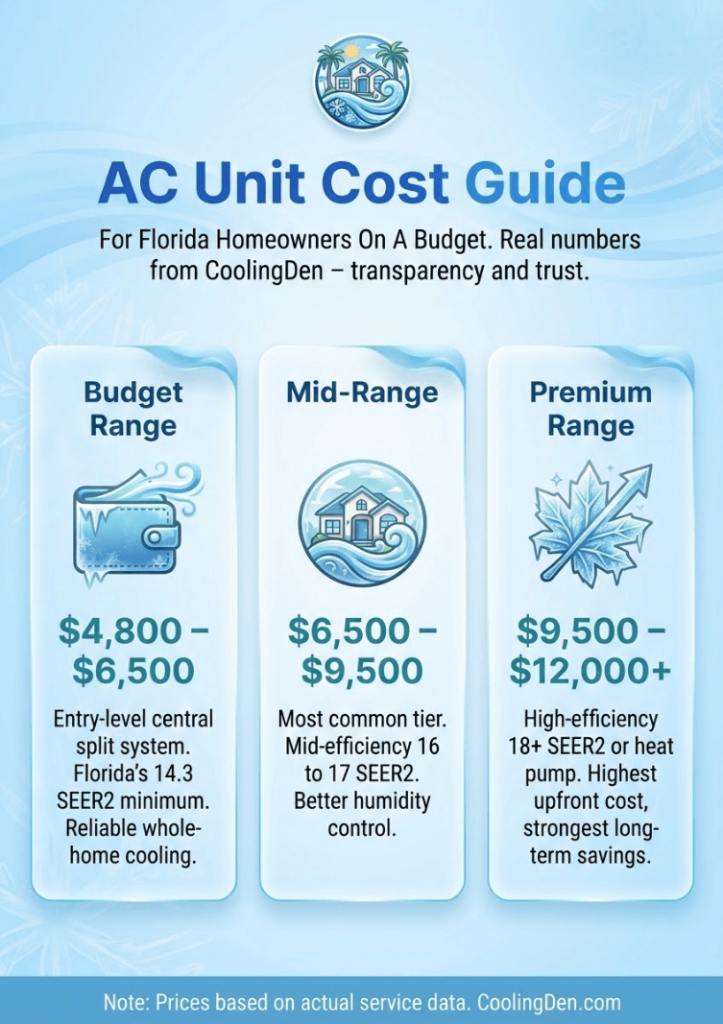
- Budget range ($4,800–$6,500): Entry-level central split system at Florida’s 14.3 SEER2 minimum. Reliable whole-home cooling with standard installation.
- Mid-range ($6,500–$9,500): Most common tier we install. Mid-efficiency 16–17 SEER2 system with better humidity control and lower monthly energy costs.
- Premium range ($9,500–$12,000+): High-efficiency 18+ SEER2 or heat pump system. Highest upfront cost but strongest long-term savings and tax credit eligibility.
What most people miss:
- Federal tax credits and utility rebates can reduce your cost by $750–$3,200+
- An oversized unit costs more to buy and more to run — proper sizing matters more than brand
- The cheapest quote almost never equals the lowest total cost of ownership
One sentence answer: Most Florida homeowners pay $4,800–$12,000 for a fully installed central AC system, with final cost determined by system size, SEER2 rating, ductwork condition, and installation complexity.
Top Takeaways
- Florida AC unit costs range from $4,800 to $12,000 installed.
- Price depends on system type, SEER2 rating, ductwork, and installation complexity
- Knowing what drives the cost helps you avoid overpaying
- Florida homeowners spend up to 27% of energy costs on AC alone.
- That’s more than double the 12% national average
- The right efficiency rating pays for itself faster here than almost anywhere else
- Proper sizing saves more than the cheapest quote.
- Oversized units short-cycle, waste energy, and fail sooner
- Always request a Manual J load calculation — not a square-footage guess
- Tax credits and rebates can save you $750 to $3,200+.
- Federal credits and Florida utility rebates stack together
- Check eligibility before your install — not after
- The most expensive AC decision is a rushed one.
- Compare at least three written quotes
- Verify contractor credentials and system sizing
- Homeowners who plan ahead consistently get better value and longer-lasting comfort
Table of Contents
How Much Does a New AC Unit Cost in 2025?
For most homeowners, a new AC unit costs between $3,000 and $15,000 — with the national average landing around $8,500 installed. Here in Florida, we typically see central air replacement costs between $4,800 and $12,000 depending on home size, system type, and efficiency rating.
That’s a wide range, and it’s exactly why understanding what drives the price matters before you sign anything.
What Factors Affect AC Unit Cost the Most?
Not every home needs the same system, and not every quote reflects the same scope of work. From our experience installing and replacing AC systems across Orlando, North Palm Beach, and Clermont, these are the biggest cost drivers we see:
- System size (tonnage). A unit that’s too large wastes energy and wears out faster. Too small, and it runs nonstop without cooling properly. Most Florida homes between 1,500–2,500 sq ft need a 2.5 to 4-ton system.
- SEER2 efficiency rating. Florida now requires a minimum of 14.3 SEER2 for split-system air conditioners. Higher-rated systems cost more upfront but reduce monthly energy bills significantly — air conditioning accounts for roughly 12% of household electricity use nationwide Department of Energy, and that figure climbs much higher in Florida’s hot-humid climate, where AC can represent up to 27% of total home energy costs U.S. Energy Information Administration.
- Ductwork condition. Damaged, leaky, or undersized ducts can add $1,500 or more to your project. We’ve seen homes where poor ductwork was causing more comfort problems than the unit itself.
- Installation complexity. Attic access, electrical panel upgrades, permit requirements, and refrigerant line modifications all impact labor costs.
- Refrigerant type. The industry is transitioning from R-410A to lower-impact refrigerants like R-32. Equipment costs for compliant units are running 8–12% higher than equivalent models from the prior year, and this trend is expected to continue through 2025.
AC Unit Cost by System Type
Different systems serve different budgets and home layouts. Here’s a realistic cost snapshot for Florida homeowners:
- Window or portable units: $150–$800. Best for single rooms or temporary cooling. No installation required for portables.
- Central air conditioner (split system): $4,800–$12,000 installed. The most common choice for Florida homes. Requires existing ductwork.
- Ductless mini-split: $3,000–$10,000 installed. Ideal for homes without ductwork, additions, or zone-specific cooling.
- Heat pump system: $4,500–$12,000 installed. Handles both heating and cooling. Gaining popularity in Florida thanks to strong federal tax incentives.
- Geothermal system: $10,000–$30,000+. Highest upfront cost but the most energy-efficient option long-term.
Understanding SEER2 Ratings and Why They Matter in Florida
Florida’s climate demands more from your AC than almost any other state. Your system runs harder, longer, and against relentless humidity — which makes efficiency ratings more than just a spec sheet number.
Florida requires a minimum SEER2 rating of 14.3 for most split-system air conditioners under 45,000 BTU/h World Population Review. But the minimum isn’t always the smartest investment. Most HVAC professionals recommend a SEER2 rating between 16 and 18 for Florida homes — upgrading from the baseline 13.4 SEER2 to an 18 SEER2 system can reduce cooling energy use by approximately 20%.
At CoolingDen, we help homeowners weigh the upfront cost difference against long-term utility savings. In many cases, a mid-range efficiency system pays for the upgrade within 5–7 years through lower monthly bills alone.
How to Save Money on a New AC Unit
Being budget-conscious doesn’t mean settling for a bad system. It means being strategic. Here’s what we tell every homeowner:
- Get at least three written quotes. Compare not just price but scope — what’s included in the install, what warranty coverage looks like, and whether permits are handled.
- Don’t oversize your system. A proper Manual J load calculation ensures you’re paying for the right capacity, not wasted tonnage.
- Time your purchase wisely. Off-season installations (fall and early spring) often come with better pricing and faster scheduling.
- Ask about rebates and tax credits. Federal tax credits for energy-efficient home improvements can reach $3,200 annually through 2032, with up to $2,000 available specifically for qualifying heat pump systems. Florida utility rebates can stack on top of that.
- Prioritize installation quality over the lowest bid. We’ve seen brand-new systems fail within two years because of improper installation. The contractor matters as much as the equipment.
When Should You Replace vs. Repair Your AC?
This is one of the most common questions we hear. Our general rule of thumb:
- If your system is under 10 years old and the repair is under $1,000, repair usually makes sense.
- If your system is 10–15 years old, weigh the repair cost against 30–50% of replacement cost. If the repair exceeds that threshold, replacement is the better investment.
- If your system is 15+ years old, replacement almost always wins. Older AC units can consume 20–40% more energy than current models This Old House, meaning you’re paying a premium every month just to keep an aging system running.
Frequent breakdowns, uneven cooling, rising energy bills, and R-22 refrigerant dependency are all strong signals that it’s time to invest in a new unit rather than pouring money into repairs.
Financing Options for Budget-Conscious Homeowners
A new AC unit is a significant investment, but you don’t have to pay for it all at once. Most reputable HVAC companies — including CoolingDen — offer financing options that spread the cost into manageable monthly payments.
Look for providers that offer zero-interest promotional periods, transparent terms with no hidden fees, and flexible payment timelines that align with your budget. Combined with available tax credits and utility rebates, financing can make a high-efficiency system surprisingly affordable.
Why Florida Homeowners Pay More for AC (And How to Offset It)
In the hot-humid climate region, 94% of households rely on air conditioning, and cooling represents the single largest share of home energy costs U.S. Energy Information Administration. Florida’s year-round heat, coastal humidity, and salt-air exposure all place extra demands on HVAC equipment — meaning systems work harder, wear faster, and cost more to operate than in milder climates.
That’s exactly why getting the right system at the right price matters here more than almost anywhere else. At CoolingDen, we’ve built our approach around helping Florida homeowners make smart cooling investments — not rushed decisions driven by a broken system in July.
“After helping hundreds of Florida homeowners navigate AC replacement costs, the biggest mistake we see isn’t choosing the wrong unit — it’s rushing into a decision without understanding what’s actually driving the price. A 10-minute conversation about your home’s layout, ductwork condition, and efficiency goals can save you thousands.”
Essential Resources on AC Unit Cost
At CoolingDen, we believe an informed homeowner is a confident homeowner. We’ve pulled together these trusted federal resources — all from .gov and .org domains — that we regularly reference ourselves when helping Florida families make smart cooling decisions. Bookmark these before your next contractor visit.
1. Verify Any AC Unit Your Contractor Quotes Is Actually Certified
Not every system on the market meets current federal efficiency standards. The EPA’s ENERGY STAR product finder lets you search certified central air conditioners and heat pumps by rating, type, and brand. Based on our experience, this is the fastest way to confirm what you’re being quoted is up to code.
Source: ENERGY STAR — Certified Product Finder
URL:https://www.energystar.gov/productfinder/
2. Don’t Leave Up to $3,200 in Federal Tax Credits on the Table
This is one of the most overlooked savings opportunities we see with our Florida customers. The IRS breaks down exactly which AC and heat pump installations qualify for the Energy Efficient Home Improvement Credit — including credit limits, eligibility rules, and what paperwork to keep.
Source: Internal Revenue Service — Energy Efficient Home Improvement Credit
URL:https://www.irs.gov/credits-deductions/energy-efficient-home-improvement-credit
3. Understand Which HVAC Products Qualify Before You Commit
ENERGY STAR’s federal tax credit guide is the clearest breakdown we’ve found for figuring out which equipment qualifies, how to combine credits, and what documentation your installer should provide. We walk our customers through this resource before every major install.
Source: ENERGY STAR — Federal Tax Credits for Energy Efficiency
URL:https://www.energystar.gov/about/federal-tax-credits
4. Check for Local Utility Rebates Most Florida Homeowners Miss
Here’s something we’ve learned firsthand — many homeowners don’t realize their Florida utility provider offers rebates that stack directly on top of federal tax credits. Plug your ZIP code into the ENERGY STAR Rebate Finder and see what’s available in your area before scheduling an install.
Source: ENERGY STAR — Rebate Finder URL:https://www.energystar.gov/rebate-finder
5. Make Sure Your System Is Sized Right — Not Just Guessed
After years of servicing Florida homes, we can tell you that oversized AC units are one of the most expensive mistakes homeowners make. The ACCA’s Manual J is the national standard for calculating your home’s actual heating and cooling load. If your contractor isn’t referencing it, that’s a red flag.
Source: Air Conditioning Contractors of America — Manual J Residential Load Calculation URL:https://www.acca.org/standards/technical-manuals/manual-j
6. Explore Every Cooling Option Before Locking Into One System
Central air isn’t the only path to staying comfortable in Florida. The DOE’s home cooling overview covers heat pumps, ductless mini-splits, and energy-efficient alternatives — plus maintenance tips and links to additional savings programs. We use this resource ourselves when advising customers on the best fit for their home and budget.
Source: U.S. Department of Energy — Home Cooling Systems
URL:https://www.energy.gov/energysaver/home-cooling-systems
Supporting Statistics on AC Unit Cost
We don’t just quote numbers at CoolingDen — we live them. Every service call across Orlando, North Palm Beach, and Clermont reinforces what federal research already confirms.
1. Florida Homeowners Spend More Than Double the National Average on AC
The U.S. Energy Information Administration found that households in the hot-humid region spend an average of $525 per year on air conditioning — 27% of total home energy costs. The national average is just 12%.
We see this gap every week:
- A 12-year-old system in Clermont pushing summer bills past $350/month
- An aging unit that doesn’t just underperform — it bleeds money quietly
- Homeowners shocked to learn their AC costs more than heating, water, and lighting combined
That’s why we walk every customer through efficiency options before talking price tags. In Florida’s climate, the wrong SEER rating costs you more than the unit itself.
Source: U.S. Energy Information Administration
URL:https://www.eia.gov/todayinenergy/detail.php?id=36692
2. Nearly One-Fifth of All Household Electricity Goes to Air Conditioning
Federal data confirms: AC consumed roughly 19% of all residential electricity in the U.S. in 2020 — about 254 billion kilowatt-hours.
In Florida, that share climbs even higher. Our systems run 8–10 months a year.
After years of servicing Florida homes, one pattern stands out:
- Properly sized, mid-to-high efficiency units consistently cut cooling costs 20–30%
- Oversized systems cycle too frequently, waste energy, and wear out faster
- The cheapest unit on paper is almost never the cheapest to own
We’ve learned that lesson alongside our customers hundreds of times over.
Source: U.S. Energy Information Administration
URL:https://www.eia.gov/tools/faqs/faq.php?id=1174&t=1
3. Air Conditioning Is Not Optional in Florida — It’s Essential Infrastructure
The U.S. Department of Energy reports that 88% of American homes now use AC, with two-thirds relying on central systems. In our region, 94% of households in the hot-humid climate zone depend on air conditioning.
For the families we work with, a functioning AC is:
- A health and safety essential — not a comfort upgrade
- The single most-used system in the home
- The biggest factor in monthly energy costs year-round
That reality shapes every recommendation we make. When we discuss AC unit cost with a homeowner, we’re not selling a product. We’re helping them protect the one system their household depends on every single day.
Source: U.S. Department of Energy
URL:https://www.energy.gov/energysaver/air-conditioning
Final Thoughts on AC Unit Cost
Replacing an AC unit is one of the biggest home investments a Florida homeowner will make. The numbers are real — $3,000 for a basic system up to $12,000+ for a high-efficiency central air installation.
Your final price depends on:
- SEER2 efficiency rating
- System size and tonnage
- Ductwork condition and layout
- Installation complexity and contractor quality
- Available tax credits, rebates, and financing
We built this guide to put that knowledge in your hands before you sign anything.
Our Honest Take From the Field
After years of installing, repairing, and replacing AC systems across Orlando, North Palm Beach, and Clermont, here’s what we know for certain:
The most expensive AC decision a Florida homeowner can make is a rushed one.
We’ve seen the pattern too many times:
- A system fails on a 95-degree Saturday in July
- The homeowner panics and takes the first quote
- Two years later, the unit is short-cycling, humidity won’t drop, and electric bills have doubled
That story doesn’t have to be yours.
What Smart AC Buyers Do Differently
The homeowners who get the best value — not just the lowest price — share a few habits:
- They ask about Manual J load calculations before accepting a quote
- They compare SEER2 ratings against their actual energy usage
- They verify the contractor is sizing to their home — not guessing by square footage
- They check for rebates and tax credits before the install, not after
The CoolingDen Perspective
Transparency saves more money than any coupon ever will.
We don’t believe in pressure tactics or inflated quotes. We believe in:
- Honest conversations over sales pitches
- Clear numbers over vague estimates
- Recommendations built around your home’s needs and your family’s real budget
Florida’s climate demands more from your AC than almost any other state. The heat is relentless. The humidity is punishing. Your system carries that weight every day — March through November and sometimes longer.
That’s not a reason to overspend. It’s a reason to spend wisely.
FAQ on AC Unit Cost
Q: How much does a new AC unit cost in Florida?
A: Most Florida homeowners pay between $4,800 and $12,000 fully installed. From what we’ve seen across hundreds of CoolingDen installations, the final price depends on:
- System size and tonnage
- SEER2 efficiency rating
- Ductwork condition and modifications
- Installation scope and complexity
For a typical 1,500–2,500 sq ft Florida home, costs most often settle between $6,000 and $9,500 with a mid-efficiency unit. The homeowners who feel best about their purchase are the ones who understood the breakdown before signing.
Q: What is the cheapest type of AC unit for homeowners on a budget?
A: Window and portable units are the cheapest to buy at $150–$800. No installation required. But for whole-home cooling, here’s what we tell budget-conscious homeowners:
- The cheapest unit to buy is rarely the cheapest to own
- We’ve watched families save $500 upfront — then spend $1,200 more per year in energy costs
- An entry-level central split system at Florida’s 14.3 SEER2 minimum delivers reliable whole-home comfort
- Proper sizing is the single biggest factor in whether a budget unit saves money or quietly drains it
Bottom line: look at total cost of ownership, not just the sticker price.
Q: Are there tax credits or rebates available for a new AC unit?
A: Yes — and most homeowners don’t know about them until after they’ve paid full price. We bring this up with every CoolingDen customer before the install.
Available incentives include:
- Federal tax credit: Up to $600 for qualifying central air conditioners
- Federal tax credit: Up to $2,000 for qualifying heat pump systems
- Florida utility rebates: Local programs that stack directly on top of federal credits
- Combined savings: $750 to $3,200+ off total out-of-pocket cost
The key: check eligibility before your install date. Not after. We make this part of every pre-installation conversation because leaving that money on the table is one of the most avoidable mistakes we see.
Q: How do I know what size AC unit my home needs?
A: This comes up on almost every service call — and it’s where we see the most costly mistakes.
The only reliable method is a Manual J load calculation. It factors in:
- Square footage and ceiling height
- Insulation levels and window orientation
- Ductwork layout and condition
- Florida-specific climate data
Here’s the problem we run into regularly:
- A contractor skips Manual J and sizes by square footage alone
- The system gets oversized
- It cycles on and off too quickly and never removes humidity properly
- Components burn out faster — sometimes in under three years
We’ve pulled out units less than three years old that failed not from defects but from being too big for the home. At CoolingDen, Manual J isn’t optional. It’s where the conversation starts.
Q: Is it worth paying more for a higher SEER2 rated AC unit?
A: In almost every Florida home we service — yes. It’s not even close.
Here’s what we’ve tracked across our customer base:
- Upgrading from 14.3 to 16–18 SEER2 saves $200–$400 per year on cooling costs
- Over a 15-year system lifespan, that’s $3,000–$6,000 back in your pocket
- The upfront difference pays for itself within 5–7 years
- After that, it’s pure savings
We recommend the 16–18 SEER2 range for most Florida homes because it hits the sweet spot between:
- Upfront investment and long-term return
- Energy performance and equipment cost
- Comfort and budget — without overengineering the system
That’s before tax credits and rebates even enter the picture.
Ready to Find the Right AC Unit for Your Budget? Let’s Talk.
Understanding AC unit costs is the first step — getting a transparent, no-pressure consultation tailored to your Florida home is the next. Contact CoolingDen today and let our team help you make a smart, budget-friendly cooling decision you’ll feel confident about for years to come.