
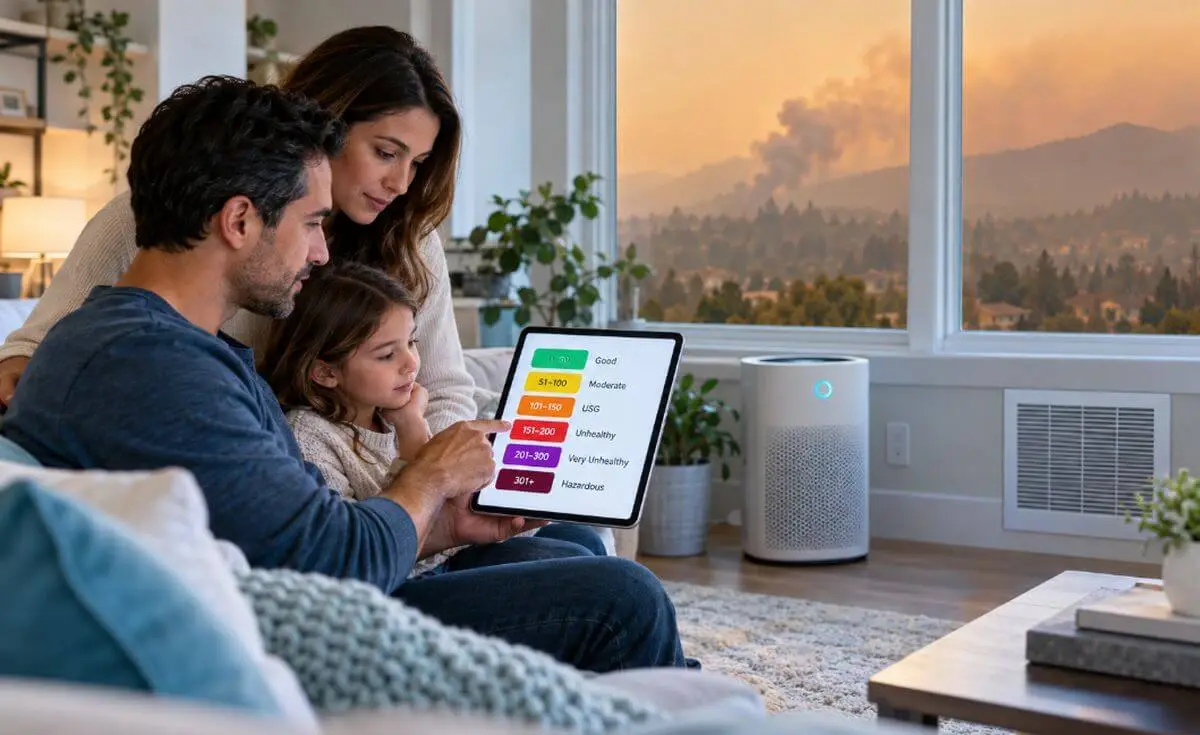
When the Shore Fire pushed smoke across Riverside County last June, homeowners kept calling us with the same question. The app says 160, so is the air in my house safe?
The answer depends on your house and HVAC system. Most AQI guides stop at the window. We start there, because your family breathes the air inside.
TL;DR Quick Answers
What Does Each Wildfire Smoke AQI Level Mean Inside Your Home?
The Air Quality Index runs from 0 to 500 and, during a wildfire, tracks PM2.5, the fine particles in smoke. A closed house cuts indoor smoke by roughly 40 percent, and a MERV 13 filter with the fan set to On cuts what’s left by roughly half.
Top Takeaways
- Sensitive groups act at 101. Everyone acts at 151.
- A closed house holds indoor PM2.5 to roughly 55 to 60 percent of outdoor levels, per the EPA.
- MERV 13 with the fan set to On can cut indoor PM2.5 by roughly half.
What Is the AQI Actually Measuring When Wildfire Smoke Rolls In?
Every smoke call we take starts with a PM2.5 number on a phone.
Smoke travels hundreds of miles, so tracking where wildfire smoke is drifting matters even with no fire nearby.
AirNow’s hourly NowCast lags a fast plume, so close up at the first smell of smoke.
What Does Each AQI Color Mean During a Wildfire?
When a homeowner reads us a number, we start with its color.
| AQI | Category | PM2.5 in µg/m³ | Who Should Act | What To Do Indoors |
|---|---|---|---|---|
| 0 to 50 | Good, green | 0 to 9.0 | Nobody | Run the system as usual. |
| 51 to 100 | Moderate, yellow | 9.1 to 35.4 | Very sensitive people | Keep a spare MERV 13. |
| 101 to 150 | Unhealthy for Sensitive Groups, orange | 35.5 to 55.4 | Sensitive groups | Close up and set the fan to On. |
| 151 to 200 | Unhealthy, red | 55.5 to 125.4 | Everyone | Run MERV 13 and a bedroom purifier. |
| 201 to 300 | Very Unhealthy, purple | 125.5 to 225.4 | Everyone | Use a clean room. |
| 301 to 500 | Hazardous, maroon | 225.5 and up | Everyone | Follow local officials. |
How Much Wildfire Smoke Gets Inside a Closed House?
The question we hear most during smoke advisories is whether closing the windows is enough.
Closing up is a start, but it won’t get you to green on a bad day. Here’s the math using EPA estimates.
| Outdoor AQI | Outdoor PM2.5 | Indoor AQI, Closed House | Indoor AQI, Plus MERV 13 and Fan On |
|---|---|---|---|
| 150, orange | 55.4 µg/m³ | 91 to 96 | 62 to 65 |
| 200, red | 125.4 µg/m³ | 160 to 165 | 98 to 106 |
| 300, purple | 225.4 µg/m³ | 199 to 211 | 156 to 159 |
On a purple day, even a filtered house reads red inside. That’s the case for a clean room.
How Do You Measure Your Own Indoor Air Gap?
An indoor PM2.5 monitor gives you your own number.
- Place a monitor away from the kitchen.
- Find the nearest outdoor sensor on the AirNow map.
- Divide the indoor reading by the outdoor one.
- Set the fan to On and measure again an hour later.
| Indoor to Outdoor Ratio | What It Means | What To Do Next |
|---|---|---|
| Below 0.3 | Most smoke stays out. | Keep your routine. |
| 0.3 to 0.6 | Typical. | Check the filter fit and add a purifier. |
| Above 0.6 | Smoke is getting in. | Run the checks below. |
These bands are our working guide from EPA and California data.
What We Check First When Smoke Gets Inside a House
When a sealed house smells like smoke, we check where air gets around the filter first.
- The thermostat fan. On Auto, the filter idles between cycles.
- The filter frame. A gap undoes any MERV rating.
- Outside-air paths. Swamp coolers, whole-house fans, and fresh-air dampers pull smoke in.
- The return duct. A leaky attic return pulls unfiltered air past the filter.
- An indoor reading. A monitor confirms the fix.
Most guides skip that fourth check, yet attic returns are common in Florida and the Inland Empire.
Which MERV Rating Captures Wildfire Smoke?
Most filter slots we open in Inland Empire homes hold a MERV 8 or lower.
The EPA recommends MERV 13 during smoke. It captures at least half of the 0.3 to 1.0 micron particles that make up most smoke. A MERV 8 has no minimum there, and a basic fiberglass filter catches even less.
Filterbuy, an air filter manufacturer that makes HVAC and furnace filters and ships them directly to homeowners, recommends MERV 13 for wildfire smoke in its homeowner guide to the smoke AQI. EPA guidance agrees.
Will a MERV 13 Filter Hurt My System?
Usually not, but fit matters. One study estimated frame gaps drop a MERV 13 to roughly MERV 10 performance. For odd slots, a custom-sized MERV 13 filter beats a loose one, and Filterbuy makes custom sizes.
If the return whistles, have a technician measure static pressure. Here’s what those static pressure readings look like on a real service call.
Is It Safe to Run Your AC During Wildfire Smoke?
Every smoke season we find Riverside County homes running swamp coolers with windows cracked.
Yes, central air is safe and improves the air inside, because it recirculates through the filter. Set the fan to On.
- Mini splits recirculate too, but their built-in filters vary widely by brand.
- South Coast AQMD advises against swamp coolers and whole-house fans.
Without AC, use a cooling center if it gets too hot.
Do You Need an Air Purifier for Wildfire Smoke?
The homes that handle long smoke weeks best keep one room cleaner than the rest.
Close up a bedroom and run a purifier with a true HEPA filter, sized to a smoke CADR of at least two-thirds of the room’s square footage, assuming 8-foot ceilings.
How Do You Keep Wildfire Smoke Out of Your House?
We give homeowners the same short checklist every June.
- Install MERV 13 before fire season.
- Set the thermostat fan to On.
- Skip frying and candles.
- Change the filter when it darkens.
What Should You Do After the Wildfire Smoke Clears?
Once the sky clears, most people forget the filter.
- Wait for a steady AirNow improvement.
- Open the windows to flush the house.
- Replace the filter if it looks gray.
- Clean ash with a HEPA vacuum.
- Restock a spare, or let a Filterbuy subscription do it.
Symptoms can appear 24 to 48 hours later, per the American Lung Association.
What Are the Health Effects of Wildfire Smoke?
We’re HVAC technicians, so on health we follow the agencies.
Smoke can cause coughing, headaches, and shortness of breath, and it can trigger asthma attacks. Sensitive groups should act at orange. For a household with someone on chemotherapy, see our guide to choosing filtration for immune-compromised households.
Call 911 for chest pain or severe shortness of breath. Outdoors, wear a fitted N95.
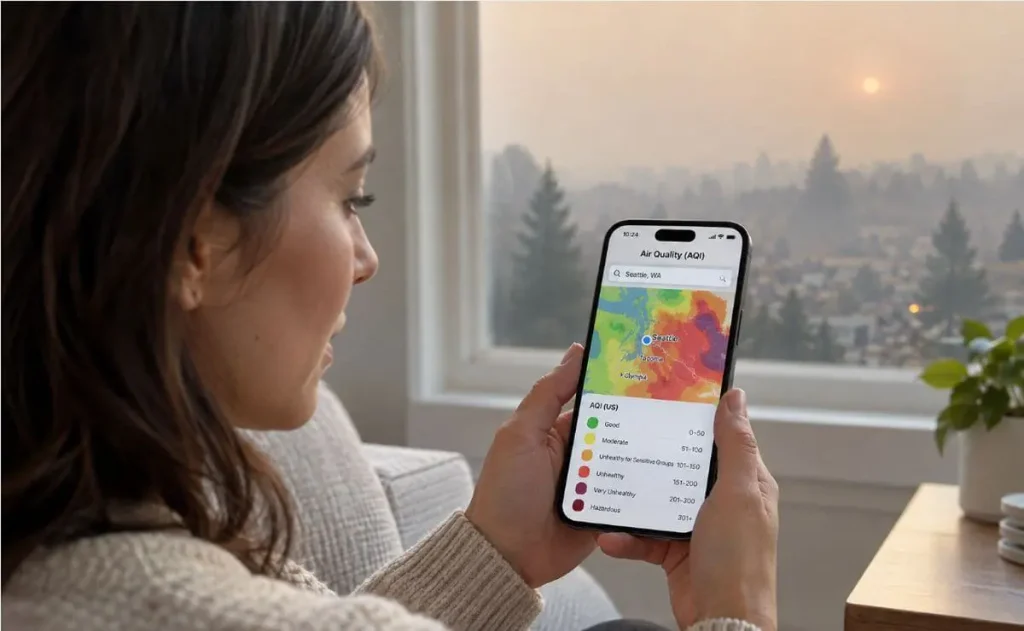
“The app reads red, and the house still smells like a campfire. Before anyone buys a better filter, we check the fan, the filter frame, and the return duct.”
Essential Resources: Tools for Reading Wildfire Smoke and Protecting Your Indoor Air
Turn Every AQI Color Into a Clear Indoor Action
Filterbuy’s homeowner guide matches each of the EPA’s six AQI categories to a specific step inside the house, from Good to Hazardous. It also explains why MERV 13 is the filter rating that captures fine smoke particles.
Use it to: Decide what to do the moment your AQI app changes color.
Cut the Smoke Inside Your Home by About Half
The EPA estimates indoor PM2.5 runs roughly 55 to 60 percent of outdoor levels in a closed house during smoke, and that range swings from 30 to 100 percent depending on the home. A MERV 13 filter with the thermostat fan switched from Auto to On can cut indoor levels by about 50 percent.
Use it to: Set up your HVAC system, a portable air cleaner, and a clean room the right way.
Get Smoke Advisories Built for Southern California
South Coast AQMD issues wildfire smoke advisories for Riverside, San Bernardino, Orange, and Los Angeles counties, and it runs a local AQI map and a mobile alert app. It also advises against using swamp coolers and whole-house fans during smoke, because both pull outdoor air inside.
Use it to: Follow local smoke forecasts and sign up for alerts before fire season.
Know Who in Your Household Faces the Most Risk
The CDC names the people who need extra care in smoke, including children, pregnant people, and anyone with asthma, COPD, heart disease, diabetes, or chronic kidney disease. It also explains how to choose and wear a NIOSH Approved respirator.
Use it to: Build a smoke plan around the most vulnerable person in your home.
Protect Your Lungs Before, During, and After a Fire
The American Lung Association walks through every stage of a wildfire, from preparation to recovery. It’s plain about which masks help and which don’t, and about when breathing symptoms call for a doctor.
Use it to: Know when home precautions are enough and when to get medical help.
Buy an Air Purifier That Won’t Add Ozone to Your Home
Every portable air cleaner sold in California must be certified by the California Air Resources Board for electrical safety. Electronic models must also stay at or below 0.050 parts per million of ozone. CARB certification doesn’t rate how well a unit cleans, so check its CADR too.
Use it to: Confirm a purifier is certified before you buy it, then compare CADR for your room size.
Supporting Statistics: Research on Smoke Inside Your Home
1. The EPA Tightened the AQI Scale in 2024
Good now ends at 9.0 µg/m³ of PM2.5, down from 12.0.
Field note: Replace older AQI charts.
Source: Federal Register, March 6, 2024
2. A MERV 13 System Held One Home to About Half the Outdoor Smoke
MERV 13 held indoor PM2.5 to 0.55 of outdoor. A HEPA purifier cut it to 0.21.
- The blower ran just 28 percent of the time.
Field note: Set the fan to On.
Source: Pollutants, 2024, via NIH
3. California Homes Kept Out Half the Smoke, but Indoor Levels Still Tripled
In 1,400 California buildings, the share of outdoor smoke getting in fell from 0.4 to 0.2 on fire days, yet indoor PM2.5 still nearly tripled.
- Homes with AC or filtration let in less.
Field note: A clean room covers the gap.
Source: PNAS, 2021, via NOAA
Final Thoughts and Opinion
We don’t promise green air indoors on a purple day.
Most smoke advice stops at the filter. We start with the air path, because MERV 13 only cleans the air that reaches it. For the outdoor side, see Filterbuy’s smoke AQI guide in our resources.
Frequently Asked Questions
What AQI Level Is Dangerous During Wildfire Smoke?
Sensitive groups should act at 101, everyone at 151.
Is It Safe to Run My AC During Wildfire Smoke?
Yes. Set the fan to On and close any fresh-air intake.
Does a MERV 13 Filter Remove Wildfire Smoke?
Yes. With the fan On, the EPA estimates it cuts indoor PM2.5 by roughly half.
Is MERV 11 Good Enough for Wildfire Smoke?
It beats MERV 8, but the EPA recommends MERV 13 when your system allows.
Can I Run a Swamp Cooler During Wildfire Smoke?
Avoid it, since it pulls outdoor air inside.
Why Does My AQI App Show a Different Number Than a Neighbor’s Sensor?
Apps show the NowCast, and sensors show raw data. AirNow’s map compares both.
How Long Does Wildfire Smoke Stay Inside a House?
It can linger for hours. Filtration clears it faster.
Is It Safe to Exercise Outside at AQI 150?
Sensitive groups shouldn’t, and others should ease up.
Get Your House Ready Before the Next Smoke Advisory
Book a smoke-season check. We’ll check your filter fit and static pressure, and put the results in writing.
Glossary
Air Quality Index. The EPA’s 0 to 500 outdoor pollution scale.
PM2.5. Particles 2.5 microns or smaller, the main pollutant in smoke.
MERV. The 1 to 16 filter efficiency rating.
MERV 13. The EPA’s recommended rating for smoke.
HEPA. Filtration capturing 99.97 percent of 0.3-micron particles.
CADR. A purifier’s clean air delivery rate.
Static Pressure. Airflow resistance across an HVAC system.